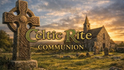


An Introduction to Celtic Christianity
Celtic Christianity is not a romantic invention nor a fringe spirituality, but a living expression of the one, holy, catholic, and apostolic faith as it took root on the western edges of the Roman world. Shaped by Scripture, ascetic devotion, missionary courage, and a deep sacramental vision of creation, it developed in relative freedom from imperial control and later came into tension with the expanding authority of Rome.
The story often begins—at least in the British imagination—with Joseph of Arimathea, who according to early British tradition brought the Gospel to the isles following the Resurrection of Christ. While this tradition cannot be proven historically, it reflects an early and persistent belief that Christianity in Britain did not originate solely as an extension of Roman imperial mission, but possessed ancient and independent roots.¹
By the fourth century, Christianity was firmly established in Roman Britain, producing martyrs such as St. Alban and bishops who attended continental councils, including the Council of Arles (AD 314).² Yet it was in the fifth and sixth centuries that what we now call Celtic Christianity fully emerged.
St. Patrick and the Irish Church
At the heart of this story stands St. Patrick, apostle to Ireland. Acting beyond the reach of Roman legions and imperial administration, Patrick evangelized a land organized around kinship and tribal loyalty rather than cities. The Irish Church that emerged was monastic in structure, missionary in spirit, and deeply penitential.
Authority was often exercised by abbots rather than diocesan bishops, not in rejection of episcopacy, but as an adaptation to a non-urban culture. Bishops remained essential for sacramental life and ordination, yet they frequently served under the spiritual leadership of monastic founders.³
Patrick’s legacy was a Church marked by prayer, fasting, Scripture, learning, and a profound awareness of God’s nearness in daily life.
The Missionary Saints: Columba and Aidan
From Ireland the faith spread outward again. St. Columba founded the monastery of Iona in 563, which became the spiritual heart of Christianity among the Picts and Scots. From Iona flowed a missionary movement characterized by ascetic discipline, pastoral gentleness, and deep reverence for creation.
From this same tradition came St. Aidan, who founded Lindisfarne at the invitation of King Oswald of Northumbria. Bede praises Aidan for his humility, generosity, and personal holiness, noting that he taught “more by example than by force.”⁴
The Synod of Whitby (664)
As the Celtic churches expanded, differences with Roman practice became increasingly visible—most notably concerning the dating of Easter, the monastic tonsure, and questions of authority. These tensions culminated in the Synod of Whitby.
Whitby was not merely a calendrical dispute; it marked a decisive shift toward Roman uniformity and centralized authority. When King Oswiu ruled in favor of Roman practice, the Celtic tradition lost royal and institutional support in much of England.⁵
Retreat, Survival, and Hidden Faithfulness
In the generations following Whitby, many Celtic Christian communities withdrew into Ireland, the Scottish Highlands and Islands, and other remote regions—places beyond effective Roman administrative reach. There, older patterns of prayer, pilgrimage, blessing, and monastic life continued quietly.
This retreat was not schism but preservation. The Celtic churches did not see themselves as abandoning catholic faith, but as safeguarding a way of life rooted in Scripture, asceticism, and intimacy with God.
Celtic and Insular Bishops in Early Anglican Ordinations
At the English Reformation, the Church of England did not understand itself as creating a new church, but as reforming an existing one while maintaining apostolic succession. Crucially, this succession did not depend solely upon Roman approval.
While the earliest Anglican bishops (such as those consecrated in 1559) were ordained by English bishops who themselves stood within the historic episcopate, later developments in Ireland and Scotland are especially significant.⁶
In 1610, the episcopate of the Church of Ireland—which had preserved historic orders independent of papal jurisdiction—consecrated bishops for the Church of Scotland, restoring episcopal succession there after its abolition during the Reformation. These consecrations were carried out by Irish bishops whose lineage traced through the ancient Irish and insular churches.⁷
Again in 1661, after the Restoration, Scottish bishops—standing in this same non-Roman yet apostolic succession—participated in consecrations that strengthened Anglican episcopal continuity.⁸
Thus, while Anglican orders are fully catholic in form and intent, they also bear the imprint of the older insular episcopal tradition, shaped by the Celtic Church’s resistance to absolute Roman centralization. This continuity is historical, sacramental, and ecclesial—not romantic, but real.
Renewal in Our Time
Today, Celtic Christianity is experiencing renewed interest—not as nostalgia, but as a prophetic witness for a fragmented age. Its emphasis on community, creation, pilgrimage, hospitality, and spiritual formation resonates deeply with modern Christians seeking depth without domination.
The Celtic saints remind us that the Church often thrives not at the center of power, but at the margins—on islands, in monasteries, and among ordinary people who live faithfully before God.
Celtic Christianity endures because it was never merely an institution. It was, and remains, a way of life:
Christ in the hearth, Christ in the stranger, Christ in all creation.
⸻
Selected Citations & Sources
1. William of Malmesbury, De Antiquitate Glastoniensis Ecclesiae
2. Council of Arles (AD 314), Canon lists of British bishops
3. Kathleen Hughes, The Church in Early Irish Society
4. Bede, Ecclesiastical History of the English People, Book III
5. Henry Mayr-Harting, The Coming of Christianity to Anglo-Saxon England
6. Richard Hooker, Of the Laws of Ecclesiastical Polity, Book VII
7. John Bramhall, A Just Vindication of the Church of England (17th c.)
8. G.W.O. Addleshaw, The High Church Tradition
9. J. Robert Wright, The Church of England and the Anglican Communion
Create Your Own Website With Webador