
Apostolic Seccession
Are Celtic Rite lines of Apostolic seccession Valid?
Apostolic Succession in an Ecumenical and Celtic Light.
For many faithful Christians, questions about apostolic succession are not abstract theological debates. They are deeply personal. They arise at hospital bedsides, in hospice rooms, at baptismal fonts, and at the altar where bread is broken and wine is shared. Beneath the technical language lies a simple longing: Is the grace I am receiving real? Is this Church truly part of the Church Christ founded?
Within the Celtic Rite—the answer offered is a quiet but confident yes.
Apostolic Succession as Care, Not Competition
In its earliest understanding, apostolic succession was never about rivalry between churches. It was about care—about ensuring that communities remained grounded in the teaching of the apostles and shepherded by those entrusted with prayer, sacrament, and oversight. The laying on of hands was not a legal mechanism but a pastoral act, a visible sign that no minister stands alone or self-appointed.
When Celtic Rite succession is approached in this spirit, it becomes clear that the question is not whether Celtic orders perfectly mirror one later-developed model, but whether they faithfully participate in the apostolic life of the Church. Ecumenically, many Christians across traditions have come to recognize that they do.
Shared Episcopal Lines as Signs of Communion
Through the participation of Old Catholic bishops, Polish National Catholic bishops, and at times Orthodox bishops, Celtic Rite consecrations have come to embody a visible ecumenical convergence. These were not acts of defiance toward Rome or the East, but gestures of trust and mutual recognition.
In these moments, the Church quietly testified that apostolic succession does not belong to one jurisdiction alone. It belongs to the whole Body of Christ. When hands from multiple historic traditions are laid upon one bishop, the act becomes a prayer for unity as much as an ordination.
The Celtic Church: An Apostolic Faith Close to the People
The Celtic Christian tradition offers a particularly pastoral lens through which to understand apostolic continuity. Long before centralized ecclesiastical authority reached the western edges of Europe, Christianity had taken deep root among the Celtic peoples of Ireland, Scotland, Wales, and parts of Britain.
This Church was unmistakably apostolic. Bishops ordained. The Eucharist was celebrated. Scripture was honored. Monastic communities became centers of prayer, learning, and mission. Apostolic succession was lived relationally—through spiritual fatherhood and motherhood, communal discernment, and deep attentiveness to the Holy Spirit.
The Celtic Church did not experience itself as separated from the wider Church, nor did it see Roman custom as the sole measure of catholicity. It was fully Christian, fully sacramental, and fully rooted in apostolic faith—yet expressed that faith through local culture, language, and rhythm of life.
Monastic Bishops and Missionary Succession
One of the most distinctive features of Celtic Christianity was its integration of episcopal and monastic life. Abbots often exercised authority alongside or even above bishops, not in opposition to apostolic order, but as an expression of it. Succession was carried not only through formal lines but through mission—through saints who founded communities, baptized nations, and passed on the faith by example as much as by institution.
Figures such as Patrick, Columba, Aidan, Brigid, and Cuthbert stand as witnesses to an apostolic succession that was pastoral, missionary, and incarnational. Their authority flowed from holiness, service, and fidelity to Christ rather than from proximity to imperial power. In this sense, Celtic lineage is not a romantic reclaiming of the past, but a living inheritance—one that affirms that apostolic succession is as much about how ministry is lived as from whom it is received.
Validity in the Service of Healing
When Celtic Rite apostolic succession is understood as a convergence of Anglican, Roman, Old Catholic, Polish National Catholic, Orthodox, and Celtic streams, its purpose becomes clearer. It exists not to prove superiority, but to serve the faithful. It assures the dying that the Eucharist they receive is real. It assures the baptized that their belonging is secure. It assures ministers that they serve not in isolation, but in communion with the Church across time and space.
This is where validity becomes pastoral.
An Ecumenical Hope
In an age marked by division and exhaustion, Celtic Rite apostolic succession—rooted in convergence rather than exclusion—offers a quiet hope. It suggests that unity may come not through erasing differences, but through recognizing the grace already present in one another’s traditions.
Celtic Christianity reminds the wider Church that holiness, hospitality, and harmony with creation are apostolic virtues. Old Catholic and Orthodox participation reminds us that succession is shared, not hoarded. The Celtic Rite, at its best, holds these truths gently, offering a space where the ancient Church can still speak in many voices.
Conclusion: A Succession for the Sake of Love
Apostolic succession, rightly understood, is not a weapon in theological debate. It is a gift given so that love, grace, and truth may continue to flow through the Church. Celtic Rite succession—enriched by Roman, Old Catholic, Polish National Catholic, Orthodox, as well as Celtic lines—stands as a testament to that gift.
For those who worship, serve, and suffer within Celtic life, this succession affirms a simple and holy truth: you belong. Your prayers are heard. Your sacraments are real. Your Church is part of the living, apostolic body of Christ.

APOSTOLIC SUCCESSION of
+Michael Zulinke, PhD., OSB., OCB.
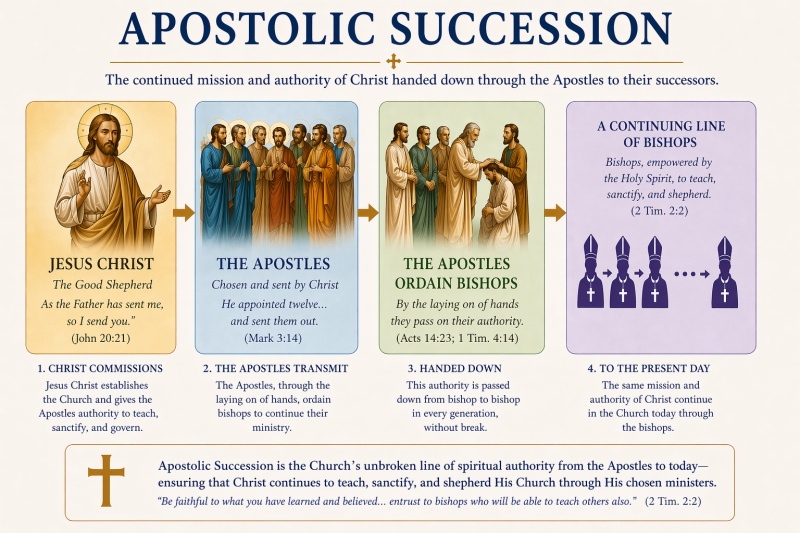
APOSTOLIC SUCCESSION
The Celtic Rite Communion and Celtic Order of Benedictine chaplains adheres to the following principles regarding the validity of orders and Apostolic Succession.
- Historically the offices of the church are denoted as Deacon, Priest and Bishop and each is, in and for itself, constituted as a distinct order, sacramental in nature, and deriving its validity from the visible sign of the laying on of hands by those who have been themselves been duly created ministers of the Church in this manner by previously having been ordained and consecrated Priests and Bishops in Apostolic Succession.
- Apostolic Succession describes a system of ordination and consecration which began with the Disciples who were chosen by Jesus and who, according to the Pastoral Letters contained in Holy Scripture, ordained and consecrated their successors, or who assented to the ordination and consecration of successor ministers of the early Christian Church.
- In the writings of the Early Church Fathers, in the historical writings of Hegesippus and Irenaeus, and in the injunctions and canons of the Council of Nicea are to be found the early and definitive records of those who were invested with Apostolic Succession and the requirements set forth for such investiture.
- It is incumbent upon this Church, therefore, to assure that those to whom it would entrust the cure of souls to minister servants of Christ, whether as Deacons, Priests or Bishops, possess an upright character, an acceptable knowledge and understanding of the Christian religion, appropriate academic learning, and those qualities of unfailing charity, humility, and whose personal lives provide a prayerful example of Christian devotion and godly living
- The concept of Apostolic Succession attempts to ensure that those who would serve as ministers of the Gospel meet with the approbation of the whole Church and not merely that of a single congregation or a sect within a denomination or even a denomination alone. Nevertheless, in every Christian community of faith some have obtained clerical status without fulfilling the justifiable expectations of the Church as a whole or the denomination in which their ordination or consecration occurred. Yet the benefit of Apostolic Succession has been successively passed to many, not by the virtue of mankind, but by the Grace of God.
- Irregularity of conferral of Apostolic Succession has occasionally occurred. The Church has always distinguished between irregular consecrations and invalid consecrations. A variety of circumstances may lead to the conclusion that a particular bishop was irregularly consecrated but that in no way prevents that bishop from imparting valid orders or sacraments to others. A bishop, on the other hand, whose consecration is invalid, is deemed not to have received Apostolic Succession in any way. The difficulty, for example in having the consecration performed by three bishops in person, often resulted in letters of consent being used as proxies for the absent prelates. Archbishops, Metropolitans, Patriarchs and Popes were assumed to have the power to make bishops solo, occasionally at some great distance, and often by other bishops commissioned for that purpose. An example of an invalid bishop would be an individual who simply took the title, style, and powers without regard to the Laying on of Hands, election or appointment to that office by competent authority.
The Deacons, Priests and Bishops of the Celtic Rite Catholic Communion derive their orders from a number of different lines of Apostolic Succession, some of which intersect, overlap, and offer an arcane study in Church history. Mindful of the history of the Church, that is, the whole of Christian church history, a brief discourse on the major sources of Apostolic Succession for clergy of this denomination may prove useful. Our clerics and bishops derive their orders from one or more of these sources of which the following list offers more specific information. The list is arranged in no particular order. In some cases only the name of one consecrating bishop is given for the simple reason that that person represents the chain of title of Apostolic Succession and the inclusion of other co-consecrators would provide no greater surety of that succession but their inclusion would, of necessity, provide a much longer, if less readable, table.
APOSTOLIC SUCCESSION Of
+Michael Zulinke, PhD., OCB., OSB.
Legendary Succession of Abbots of Glastonbury Abbey
(According to ancient tradition and medieval monastic chronicles)
Joseph of Arimathea Founder of the Glastonbury community; bearer of the Gospel to Britain.
Joseph’s Twelve Companions
The first custodians of the holy place; names vary by tradition.
Philip the Apostle Named symbolically as apostolic overseer of the British Church.
Aristobulus Traditionally called the first bishop in Britain.
Joseph the Younger(sometimes identified as Joseph’s son)
Patrick the Elder Early British missionary; distinct from Patrick of Ireland.
Patrick of Ireland -Said to have retired to Glastonbury near the end of his life.
Benignus - Companion of St. Patrick; guardian of the sacred enclosure.
Worgret (c. 601–?)
Lademund (c. 663–667)
Bregored (c. 667)
Berhtwald (c. 667–676/7) – later Archbishop of Canterbury
7th–9th Century Abbots
Haemgils (676/7–701/2)
Beorhtwald (701/2–709/10)
Ealdberht (709/10–718/9)
Ecgfrith (718/19–?)
Walhstod (729)
Coengils (?–737)
Tunberht (737–?)
Tyccea (754–760)
Guba (760–762)
Wealdhun (762–794)
Beaduwulf (794–800)
Muca (802–824)
Guthlac (824–851)
Ealhmund (851–867)
Later Medieval Abbots (10th–12th Century)
From later medieval records compiled in Glastonbury sources:
Hereferth (867–891)
Stithheard (891–922)
Aldhun (922–?)
Ælfric (dates uncertain)
Dunstan (abbot from 940, later Archbishop of Canterbury)
Aegelward (962)
Sigegar (973)
Beorhtred (1000)
Brichtwin (1017)
Aegelward (1027)
Aegelnoth (1053)
Thurstin (1078)
Herlewin (1101)
High to Late Medieval Abbots
Siegfried (1120)
Henry of Blois
St. Thomas Becket c.1162
Roger of Gloucester c.1164
Peter de Leia c.1176
Gllbert Glanvillle c.1185
William of St. Mere L’eglise c.1199
Walter de Gray c.1214
Walter Kirkham c.1249
Henry c.1255
Anthony Beck c.1284
John of Halton c.1292
Roger Northborough c.1322
William Wyvil c.1330
Ralph Stratford c.1340
William Edendon c.1346
Imon Sudbury c.1362
Thomas Brentingham c.1370
Robert Braybrooke c.1382
Roger Walden c.1398
Henry Beaufort c.1398
Thomas Bourchier c.1435
John Morton c.1479
Richard Fitzjames c.1497
William Warham c.1502
John Longlands c.1521
Thomas Cranmer c.1533 Archbishop of Canterbury.
William Barlow c.1536
Matthew Parker c.1559
Edmund Grindal c.1559
John Whitgift c.1577
Richard Bancroft c.1597
George Abbot c.1609
George Montaigne c.1617
Bl William Laud c.1621
Brian Duppa c.1638
Gilbert Sheldon c.1660
Henry Compton c.1674
William Sancroft c.1678
Thomas White c.1685
George Hickes c.1693
James Gadderar c.1712
Thomas Rattray c.1727
William Falconar c.1741
Robert Kilgour c.1768 Bishop of Aberdeen
Samuel Seabury c.1784 First Bishop of The Protestant Episcopal Church of America .T. J. Claggett c.1792
Edward Bass c.1797
Abraham Jarvis c.1797
A.,V. Griswold c 1811
J. H. Hopkins c.1832
G. D. Cummins c.1866
Charles E. Cheney c.1873
W. R. Nicholson c.1876
A. S. Richardson c.1879
Leon Chechemian c.1890
Andrew Charles Albert McLagen c.1897
James Heard c.1922
William Hall c.1939
W.W. Wallace 1945
J.W. Forrester 1979
Michael Zulinke 2011.
Hebraic Celtic Line
James, Bishop of Jerusalem & Brother of Christ (Acts 15) 2. Simeon 3. Justus I 4. Zaccheus 5. Tobias 6. Benjamin 7. John I 8. Matthias 9. Philip 10. Seneca 11. Justus II. 12. Levi 13. Ephraim 14. Joseph 15. Judas 16. Marcus 17. Cassianus 18. Publius 19. Maximus I 20. Julian 21. Caius 22. Symmachus 23. Caius 24. Julian II 25. Capito 26. Maximus II 27. Antonius 28. Valius 29. Daleanus 30. Narcissus 31. Dius 32. Germanio 33. Gordius 34..Narcissus 35. Alexander 36.Mazabanes 37. Hymenacus 38. Zambodas 39. Hermon 40. Marcarius I 41. Maximus 42. Herenius 43. Hilary 44. John II 45. Praglius 46. Juvenal 47. Anastacius 48. Martyrius 49. Salutis 50. Elias 51. John III of Jerusalem consecrated David who traveled from Wales to Jerusalem52. David as Celtic Bishop of Mineva of Wales 1519, 53. Cynog 54. Teilo 55. Ceven 56. Morfall 57. Haerwneu 58. Elwaed 59. Gwrnwen 60. Llumverth 61. Gwrgwyst 62. Gwgan 63. Eineon 64. Clydawg 65. Elfod 66. Ethelman 67. Elane 68. Magelsgwyd 69. Made 70. Cadell 71. Sadwrnfen 72. Novis 73. Sulhaithnay 74. Idwall 75. Asser 76. Arthwael 77. Samson 78. Reubin 79. Rhydderch 80. Elwin 81. Morbiw 82. Llunwerth 83. Hubert 84. Enerius 85. Ivor 86. Morgeneu I 87. Nathan 88. Jenan 89. Arwystl 90. Morgeneu II 91. Ervin 92. Trahacarn 93. Joseph 94. Bleiddud 95. Salien 96. Abraham 97. Rhyddmarch 98. Wilfrid 99. Bernard 100. D. Fitzgerald 101. P. deLeia 102. G. Camb 103. G. deHenelawe 104. Jowerth 105. Gross 106. deCarew 107. T. Hech 108. D. Martin 109. H. Gower 110. J. Thorsby 111. R. Brian 112. F. Fastolfe 113. H. Doughton 114. J. Gilbert 115. G. deMona 116. Henry Chichele as Celtic Bishop of St. David's Wales, Archbishop of Canterbury 117. J. Stalford 118. J. Kemp 119. T. Bourchier 120. J. Morton 121. H. Dean 122. W. Wareham 123. Thomas Cranmer Archbishop of Canterbury 124. R. Pole 125. M. Parker 126. E. Grindall 127. J. Whitgift 128. R. Bancroft 129. G. Abbott who co-consecrated with George Montaigne 130. William Laud, Bishop of St. David's, Archbishop of Canterbury. 131. W. Juxon 132. G. Sheldon 133. William Sancroft 134. T. White 135. G. Hickes 136. J. Gadderar 137. T. Rattray 138. W. Falconar 139. R. Kilgour Bishop of Aberdeen. 140. Samuel Seabury Bishop of Connecticut 141. T. J. Claggett 142. E. Bass 143. A. Jarvis 144. J. H. Hobart 145. H. Onderdonk 146. A. M. McCroskey 147. W. E. McClaren 1865 148. W. M. Brown 1884 149. W. Brothers 1925 150. William hall 1939 151. W.W. Wallace 1945 and in 1979 he consecrated 152. J.W. Forrester 153. M.P. Zulinke 2011.
Celtic Tables & Lines of Succession
It is important to recognize that, prior to approximately the 11th century, the tables of succession primarily refer to the lineages of those who held specific offices within the Church. While we can be confident in the validity of the consecrations themselves, the precise details surrounding who consecrated whom—or, in some instances, the exact time and circumstances of those consecrations—remain uncertain. The process of succession within the Celtic tradition, rooted deeply in the spiritual and apostolic mission of figures like St. Patrick, the Apostle of Ireland, is revered for its sacred continuity. However, due to the passage of time and the lack of comprehensive records, some aspects of these sacred transitions remain shrouded in mystery, inviting us to trust in the spiritual integrity and grace that guided these holy orders.
St Patrick Line
1) St. Patrick– consecrated 432
2) (Seachnaill) St Secundinius - consecrated
3) Sen-Phátraic - consecrated
4) Benén mac Sescnén – consecrated 467
5) Jarlaithe mac Treno – consecrated 481
6) Cormac – consecrated 497 Called bishop and abbot
7) Dubthach (elder) – consecrated 513 Called bishop
8) Ailill (elder) – consecrated 526 Called bishop
9) Ailill (younger) – consecrated 536 Called bishop
10) Dubthach – consecrated Called abbot
11) Fedelmid Find – consecrated Called abbot
12) Carláen – consecrated 588 Called bishop
13) Eochu – consecrated Called abbot
14) Senach – consecrated Called abbot
15) Mac Laisre – consecrated 623 Called abbot
16) Tómméne MacRonan – consecrated 640 bishop
17) Ségéne – consecrated 688 bishop
18) Forannán – consecrated
19) Fland Feblae mac Scandláin – consecrated abbot/bishop
20) Suibne nepos Mruichessaich – consecrated 730 bishop
21) Congusa – consecrated 732 Called bishop (also scribe)
22) Célé Petair – consecrated
23) Fer dá Chrích mac Suibni – consecrated
24) Cú Dínaisc mac Conasaig – consecrated
25) Dub dá Leithe I mac Sínaig – consecrated
26) Fóendelach mac Móenaig – consecrated
27) Airechtach ua Fáeláin – consecrated
28) Fóendelach mac Móenaig – consecrated
29) Gormgal mac Dindataig – consecrated (abbot)
30) Condmach mac Duib dá Leithe – consecrated (recognised as coarb in the Annals of Ulster in 804)
31) Torbach mac Gormáin – consecrated
32) Toicthech ua Tigernaig – consecrated
33) Nuadu – consecrated 811
34) Flandgus mac Loingsig – consecrated
35) Artrí mac Conchobair – consecrated 818 Acted as abbot and Coarb
36) Suibne mac Forandáin – consecrated Called Abbas
37) Eógan Mainistrech mac Ainbthig – consecrated abbot
38) Forindán mac Murgile – consecrated
39) Diarmait ua Tigernáin – consecrated abbot
40) Cathassach – consecrated
41) Féthgno mac Nechtain – consecrated
42) Máel Cobo mac Crundmaíl – consecrated
43) Ainmere ua Fáeláin – consecrated
44) Cathassach mac Robartaig – consecrated Bishop
45) Máel Brigte mac Tornáin – consecrated Coarb
46) Ioseph mac Fathaig – consecrated
47) Máel Pátraic mac Máel Tuile – consecrated 862
48) Fethgna – consecrated 875
49) Cathassach mac Doilgén – consecrated 883
50) Muiredach mac Fergussa – consecrated
51) Dub dá Leithe II mac Cellaig – consecrated Coarb
52) Muirecén mac Ciaracáin – consecrated Coarb
53) Máel Muire mac Eochada – consecrated
54) Amalgaid mac Máel Muire – consecrated
55) Dub dá Leithe III Máel Muire – consecrated
56) Cummascach Ua hErodáin – consecrated
57) Máel Ísu mac Amalgada – consecrated
58) Domnall mac Amalgada – consecrated
59) Cellach of Armagh consecrated bishop of Armagh on 23 September 1105
60) Muirchertach mac Domnall – consecrated
61) Mael mac Áeda meic Máel Ísu(Celsus) – consecrated 1105Ua
62) Morgair [Malachais] – consecrated 1132
63) Gilla Meic Liac mac Diarmata meic Ruaidri [Gelasius] – consecrated 1137
64) Conchobar O Conchaille [Concors] – consecrated 1174
65) Gille in Coimhedh O Caran [Gilbertus] – consecrated 1175
66) Tomaltach O Conchobair [Thomas] – consecrated 1180
67) Mael Isu Ua Cerbaill [Malachias] – consecrated 1184
68) Echdonn mac Gilla Uidir [Eugenius] – consecrated 1202
69) Lucas Neterville – consecrated 1217
70) Donatus O Fidabra – consecrated 1227
71) Albert Suebeer of Cologne – consecrated 1240
72) Reginald – consecrated 1247
73) Abraham O’Conallain – consecrated 1258
74) Mael Patraic O Scannail – consecrated 1261
75) Nicol Mac Mael Isu – consecrated 1270
76) Michael MacLochlainn – consecrated 1303
77) Dionysius – consecrated 1304
78) John Taaffe – consecrated 1306
79) Walter Jorz – consecrated 1307
80) Roland Jorz – consecrated 1311
81) Stephen Segrave – consecrated 1324
82) David Mag Oireachtaigh – consecrated 1334
83) Richard FitzRalph – consecrated 1347
84) Milo Sweetman – consecrated 1362
85) John Colton – consecrated 1383
86) Nicholas Fleming – consecrated 1404
87) John Swayne – consecrated 1418
88) John Prene – consecrated 1439
89) John Mey – consecrated 1444
90) John Bole [Bull] – consecrated 1457
91) John Foxhalls or Foxholes – consecrated 1471
92) Edmund Connesburgh – consecrated 1475
93) Ottaviano Spinelli [de Palatio] – consecrated 1480
94) John Kite – consecrated 1513
95) George Cromer – consecrated 1521
96) George Dowdall – consecrated 1543
97) Hugh Goodacre – consecrated 1552
98) Donat MacTeague – consecrated 1560
99) Adam Loftus – consecrated 1563
100) Thomas Lancaster – consecrated 1568
101) John Long – consecrated 1584
102) John Garvey – consecrated 1589
103) Henry Ussher – consecrated 1595
104) Christopher Hampton – consecrated 1613
105) George Montaigne – consecrated 1616
106) William Laud – consecrated 1633 Archbishop of Canterbury
107) William Juxon – consecrated 1660
108) Gilbert Sheldon – consecrated October 28, 1660
109) William Sancroft – consecrated January 27, 1678
110) Thomas White – consecrated 1685
111) George Hickes – consecrated 1693
112) James Gadderar – consecrated 1712
113) Thomas Rattray – consecrated June 4, 1727
114) William Falconar – consecrated Sept 10, 1741
115) Robert Kilgour – consecrated September 21, 1768
116) Samuel Seabury – consecrated November 14, 1784
117) Thomas John Claggett – consecrated September 17, 1792
118) Edward Bass - consecrated May 7, 1797
119) Abraham Jarvis - consecrated October 18, 1797
120) Alexander Viets Griswold - consecrated May 29, 1811
121) John Henry Hopkins - consecrated October 31, 1832
122) George D. Cummins - consecrated November 15, 1866
123) Charles Edward Cheney - consecrated December 14, 1873
124) William Rufus Nicholson - consecrated February 24, 1876
125) Alfred Spenser Richardson - consecrated June 22, 1879
126) Leon Chechemian - consecrated May 4, 1890
127) Andrew Charles Albert McLagen - consecrated November 2, 1897
128) James Heard - consecrated June 4, 1922
129) William Hall 1939
130)W.W. Wallace 1945
131)J.W. Forrester 1979
132)Michael Zulinke 2011.
also
Donagh, Archbishop of Dublin
1) Dúnán (also known as Donat, Donagh or Donatus) Consecrated in circa 1028
(2) Gilla Pátraic (also known as Patricius) Consecrated in 1074
(3) Donngus Ua hAingliu (also recorded as Donngus Ua hAingliu and Donat O'Haingly)Consecrated 1085
(4) Samuel Ua hAingliu consecrated 27 April 1096
(5) Gréne (also known as Gregorius) Consecrated bishop 2 October 1121
(6) Lorcán Ua Tuathail (St Laurence O'Toole) consecrated archbishop in 1162
(7) John Comyn (also known as John Cumin) consecrated 21 March 1181
(8) William of S. Mere L’Eglise consecrated on May 23, 1199
(9) Walter de Gray consecrated on October 5, 1214
(10) Walter Kirkham consecrated on December 5, 1249
(11) Henry consecrated on February 7, 1255
(12) Anthony Beck consecrated on January 9, 1284
(13) John of Halton consecrated on September 14, 1292
(14) Roger Northborough consecrated on June 27, 1322
(15) Robert Wyvil consecrated on July 15, 1330
(16) Ralph Stratford consecrated on March 12, 1340
(17) William Edendon consecrated on May 15, 1346
(18) Simon Sudbury consecrated on March 20, 1362
(19) Thomas Brentingham consecrated on May 12, 1370
(20) Robert Braybrooke consecrated on January 5, 1382
(21) Roger Walden consecrated on February 3, 1398
(22) Henry Beaufort consecrated on July 14, 1398
(23) Thomas Bourchier consecrated on May 15, 1435
(24) John Morton Consecrated on January 31, 1479
(25) Richard FitzJames consecrated on May 21, 1497
(26) William Warham consecrated on September 25, 1502
(27) John Longlands consecrated on May 15, 1521
(28) Thomas Cranmer consecrated on March 30, 1533
(29) William Barlow consecrated on June 1536
(30) Matthew Parker consecrated December 17(19), 1559
(31) Edmund Grindall consecrated December 21,1559
(32) John Whitgift consecrated April 21, 1577
(33) Richard Bancroft consecrated on May 8, 1597
(34) George Abbott consecrated December 3, 1609
(35) George Montaigne consecrated on December 14, 1617
(36) William Laud consecrated Bishop of St. David’s on November 18, 1621
(37) Brian Duppa consecrated Bishop of Chichester on June 17, 1638
(38) Gilbert Sheldon consecrated Bishop of London on October 28, 1660
(39) Henry Compton consecrated on December 6, 1674
(40) William Sancroft consecrated Archbishop of Canterbury on January 27, 1678
(41) Thomas White consecrated Bishop of Peterborough on October 25, 1685
(42) George Hickes consecrated Bishop of Thetford Febuary 21, 1693
(43) James Gadderar consecrated Bishop at Large on Febuary 24, 1712
(44) Thomas Rattray consecrated on June 24, 1727
(45) William Falconar consecrated Bishop of Caithness on Sept 10, 1741
(46) Robert Kilgour consecrated on September 21, 1768
(47) Samuel Seabury consecrated at Aberdeen on November 14, 1784
(48) Thomas John Claggett consecrated on September 17, 1792
(49) Edward Bass consecrated on May 7, 1797
(50) Abraham Jarvis consecrated on October 18, 1797
A.,V. Griswold c 1811
- H. Hopkins c.1832
- D. Cummins c.1866
Charles E. Cheney c.1873
- R. Nicholson c.1876
- S. Richardson c.1879
Leon Chechemian c.1890
Andrew Charles Albert McLagen c.1897
James Heard c.1922
William Hall C. 1939
W.W. Wallace 1945
J.W. Forrester 1979
Michael Zulinke 2011
Iona Abbey list
After the Synod of Whitby there were Celtic Communities that kept to the Celtic Way
The Iona Community (Columban Monks)
The monastery founded by Columba at Iona Abbey remained the strongest center of the Celtic tradition.
Even after Whitby, the monks of Iona continued their traditional calculation of Easter and monastic customs for several decades. They did not immediately accept the Roman decision and held to their inherited practices until about 716.
Columban Houses in Ireland and Scotland
Monasteries influenced by Columba across Ireland and Scotland also continued the Celtic usages. These communities were less directly affected by Whitby (which applied primarily to Northumbria), so they retained their traditions longer and more freely.
Celtic Clergy Who Left Northumbria
After Whitby, some clergy who refused to adopt Roman practices withdrew from Northumbria and returned to Iona or Ireland. These individuals helped preserve the Celtic tradition outside Roman-aligned regions.
The Celtic way after Whitby was preserved primarily by:
- The Iona monastic network
- Irish and Scottish monastic communities
- Clergy resistant to Roman standardization
However, over time, even these groups gradually adopted Roman practices—not because the Celtic spirituality disappeared, but because unity with the wider Church became a priority.
What endured was not just a calendar or tonsure, but a way of life:
- Deep rhythm of prayer
- Missionary monasticism
- Love of Scripture and creation
So while external practices eventually aligned with Rome, the soul of the Celtic tradition continued through the very communities that once resisted Whitby.
The Iona Abbey kept the Celtic way and continues now to promote Celtic Christianity.
IONA Succession
Saint Columba (Colum Cille) – 563–597
Baithen (Baithen mac Brénaind) – 597–600
Segenius (Ségéne mac Fiachnaí) – 600–652
Cumméne (Cumméne Fota) – 652–669
Fergna – 669–??? (brief tenure; precise dates unclear)
Diarmait – 676–679
Conamail – 679–???
Comgall mac Domangairt – c. 710–712
Cellach – early 8th c.
Dúngal – 724–??
Flannán – 730s–??
Cormac – mid-8th c.
Muiredach – late 8th c., annal reference
Diarmaid – late 8th c.
Rónán – early 9th c.
Muirchertach mac Erca – 820s
Máel Dúin – 830s (abbot during the first recorded Viking raids on Iona, 795–810)
Áed mac Cináeda – mid-9th c.
Conchad – late 9th c.
Donnchad – early 10th c.
Cellach – mid-10th c.
Máel Brigte – late 10th c., recorded in annals
Diarmait – late 10th c.
Cathassach – consecrated
Féthgno mac Nechtain – consecrated
Máel Cobo mac Crundmaíl – consecrated
Ainmere ua Fáeláin – consecrated
Cathassach mac Robartaig – consecrated Bishop
Máel Brigte mac Tornáin – consecrated Coarb
Ioseph mac Fathaig – consecrated
Máel Pátraic mac Máel Tuile – consecrated 862
Fethgna – consecrated 875
Cathassach mac Doilgén – consecrated 883
Muiredach mac Fergussa – consecrated
Dub dá Leithe II mac Cellaig – consecrated Coarb
Muirecén mac Ciaracáin – consecrated Coarb
Máel Muire mac Eochada – consecrated
Amalgaid mac Máel Muire – consecrated
Dub dá Leithe III Máel Muire – consecrated
Cummascach Ua hErodáin – consecrated
Máel Ísu mac Amalgada – consecrated
Domnall mac Amalgada – consecrated
Cellach of Armagh consecrated bishop of Armagh on 23 September 1105
Muirchertach mac Domnall – consecrated
Mael mac Áeda meic Máel Ísu(Celsus) – consecrated 1105Ua
Morgair [Malachais] – consecrated 1132
Gilla Meic Liac mac Diarmata meic Ruaidri [Gelasius] – consecrated 1137
Conchobar O Conchaille [Concors] – consecrated 1174
Gille in Coimhedh O Caran [Gilbertus] – consecrated 1175
Tomaltach O Conchobair [Thomas] – consecrated 1180
Mael Isu Ua Cerbaill [Malachias] – consecrated 1184
Echdonn mac Gilla Uidir [Eugenius] – consecrated 1202
Lucas Neterville – consecrated 1217
Donatus O Fidabra – consecrated 1227
Albert Suebeer of Cologne – consecrated 1240
Reginald – consecrated 1247
Abraham O’Conallain – consecrated 1258
Mael Patraic O Scannail – consecrated 1261
Nicol Mac Mael Isu – consecrated 1270
Michael MacLochlainn – consecrated 1303
Dionysius – consecrated 1304
John Taaffe – consecrated 1306
Walter Jorz – consecrated 1307
Roland Jorz – consecrated 1311
Stephen Segrave – consecrated 1324
David Mag Oireachtaigh – consecrated 1334
Richard FitzRalph – consecrated 1347
Milo Sweetman – consecrated 1362
John Colton – consecrated 1383
Nicholas Fleming – consecrated 1404
John Swayne – consecrated 1418
John Prene – consecrated 1439
John Mey – consecrated 1444
John Bole [Bull] – consecrated 1457
John Foxhalls or Foxholes – consecrated 1471
Edmund Connesburgh – consecrated 1475
Ottaviano Spinelli [de Palatio] – consecrated 1480
John Kite – consecrated 1513
George Cromer – consecrated 1521
George Dowdall – consecrated 1543
Hugh Goodacre – consecrated 1552
Donat MacTeague – consecrated 1560
Adam Loftus – consecrated 1563
Thomas Lancaster – consecrated 1568
John Long – consecrated 1584
John Garvey – consecrated 1589
Henry Ussher – consecrated 1595
Christopher Hampton – consecrated 1613
George Montaigne – consecrated 1616
William Laud – consecrated 1633 Archbishop of Canterbury
William Juxon – consecrated 1660
Gilbert Sheldon – consecrated October 28, 1660
William Sancroft – consecrated January 27, 1678
Thomas White – consecrated 1685
George Hickes – consecrated 1693
James Gadderar – consecrated 1712
Thomas Rattray – consecrated June 4, 1727
William Falconar – consecrated Sept 10, 1741
Robert Kilgour – consecrated September 21, 1768
Samuel Seabury – consecrated November 14, 1784
Thomas John Claggett – consecrated September 17, 1792
Edward Bass - consecrated May 7, 1797
Abraham Jarvis - consecrated October 18, 1797
Alexander Viets Griswold - consecrated May 29, 1811
John Henry Hopkins - consecrated October 31, 1832
George D. Cummins - consecrated November 15, 1866
Charles Edward Cheney - consecrated December 14, 1873
William Rufus Nicholson - consecrated February 24, 1876
Alfred Spenser Richardson - consecrated June 22, 1879
Leon Chechemian - consecrated May 4, 1890
Andrew Charles Albert McLagen - consecrated November 2, 1897
James Heard - consecrated June 4, 1922
William Hall 1939
W.W. Wallace 1945
J.W. Forrester 1979
Michael Zulinke 2011.
Inishbofin (Inis Bó Finne) and Mayo Abbey succession
Founded by: Colmán of Lindisfarne (d. c. 675)
Colmán of Inishbofin – d. c. 675 (founder; abbot-bishop)
After Colmán, the annals contain occasional references to abbots of Inishbofin, but surviving manuscripts do not preserve a consistent, continuous list comparable to larger foundations like Iona or Armagh. Names appear sporadically and sometimes ambiguously due to duplicate place names. As a result, no secure chronological abbatial succession can be reconstructed for Inishbofin.
Mayo Abbey
Established for the Northumbrian monks who followed Colmán.
Gérmán (Germanus) – Often identified as first abbot of Mayo (appointed by Colmán)
Colmán – Occasionally associated with oversight of both foundations before his death
Suairlech mac Aedha – Abbot of Mayo (d. 747)
Cathal mac Muiredaig – Abbot (d. 773)
Ailill – Abbot (late 8th century, annal reference)
Mael Dúin – Abbot (d. 805)
Indrechtach – Abbot (d. 807)
Aedh – Bishop/Abbot of Mayo (d. 858)
Cormac – styled abbot of Magh Eo (late 9th c., annal reference)
Mael Muire – abbot (d. c. 879, attributed in some annal recensions)
Cenn Fáelad – ecclesiastical leader associated with Magh Eo (late 9th c.)
Mael Brigte (Máel Brigte) – abbot of Mayo (d. early 10th c.)
Dub Dá Leithe – cleric associated with Mayo (mid-10th c.)
Muirecén mac Ciaracáin – consecrated Coarb
Máel Muire mac Eochada – consecrated
Amalgaid mac Máel Muire – consecrated
Dub dá Leithe III Máel Muire – consecrated
Cummascach Ua hErodáin – consecrated
Máel Ísu mac Amalgada – consecrated
Domnall mac Amalgada – consecrated
Cellach of Armagh consecrated bishop of Armagh on 23 September 1105
Muirchertach mac Domnall – consecrated
Mael mac Áeda meic Máel Ísu(Celsus) – consecrated 1105Ua
Morgair [Malachais] – consecrated 1132
Gilla Meic Liac mac Diarmata meic Ruaidri [Gelasius] – consecrated 1137
Conchobar O Conchaille [Concors] – consecrated 1174
Gille in Coimhedh O Caran [Gilbertus] – consecrated 1175
Tomaltach O Conchobair [Thomas] – consecrated 1180
Mael Isu Ua Cerbaill [Malachias] – consecrated 1184
Echdonn mac Gilla Uidir [Eugenius] – consecrated 1202
Lucas Neterville – consecrated 1217
Donatus O Fidabra – consecrated 1227
Albert Suebeer of Cologne – consecrated 1240
Reginald – consecrated 1247
Abraham O’Conallain – consecrated 1258
Mael Patraic O Scannail – consecrated 1261
Nicol Mac Mael Isu – consecrated 1270
Michael MacLochlainn – consecrated 1303
Dionysius – consecrated 1304
John Taaffe – consecrated 1306
Walter Jorz – consecrated 1307
Roland Jorz – consecrated 1311
Stephen Segrave – consecrated 1324
David Mag Oireachtaigh – consecrated 1334
Richard FitzRalph – consecrated 1347
Milo Sweetman – consecrated 1362
John Colton – consecrated 1383
Nicholas Fleming – consecrated 1404
John Swayne – consecrated 1418
John Prene – consecrated 1439
John Mey – consecrated 1444
John Bole [Bull] – consecrated 1457
John Foxhalls or Foxholes – consecrated 1471
Edmund Connesburgh – consecrated 1475
Ottaviano Spinelli [de Palatio] – consecrated 1480
John Kite – consecrated 1513
George Cromer – consecrated 1521
George Dowdall – consecrated 1543
Hugh Goodacre – consecrated 1552
Donat MacTeague – consecrated 1560
Adam Loftus – consecrated 1563
Thomas Lancaster – consecrated 1568
John Long – consecrated 1584
John Garvey – consecrated 1589
Henry Ussher – consecrated 1595
Christopher Hampton – consecrated 1613
George Montaigne – consecrated 1616
William Laud – consecrated 1633 Archbishop of Canterbury
William Juxon – consecrated 1660
Gilbert Sheldon – consecrated October 28, 1660
William Sancroft – consecrated January 27, 1678
Thomas White – consecrated 1685
George Hickes – consecrated 1693
James Gadderar – consecrated 1712
Thomas Rattray – consecrated June 4, 1727
William Falconar – consecrated Sept 10, 1741
Robert Kilgour – consecrated September 21, 1768
Samuel Seabury – consecrated November 14, 1784
Thomas John Claggett – consecrated September 17, 1792
Edward Bass - consecrated May 7, 1797
Abraham Jarvis - consecrated October 18, 1797
Alexander Viets Griswold - consecrated May 29, 1811
John Henry Hopkins - consecrated October 31, 1832
George D. Cummins - consecrated November 15, 1866
Charles Edward Cheney - consecrated December 14, 1873
William Rufus Nicholson - consecrated February 24, 1876
Alfred Spenser Richardson - consecrated June 22, 1879
Leon Chechemian - consecrated May 4, 1890
Andrew Charles Albert McLagen - consecrated November 2, 1897
James Heard - consecrated June 4, 1922
William Hall 1939
W.W. Wallace 1945
J.W. Forrester 1979
Michael Zulinke 2011.
Canterbury Line
1 597 Augustine
2 604 Laurentius
3 619 Mellitus
4 624 Justus
5 627 Honorius
6 655 Deusdedit
7 668 Theodore
8 693 Berhtwald
9 731 Tatwine
10 735 Nothelm
11 740 Cuthbert
12 761 Bregowine
13 765 Jaenbert
14 793 Ethelhard
15 805 Wulfred
16 832 Feologeld
17 833 Ceolnoth
18 870 Ethelred
19 890 Plegmund
20 914 Athelm
21 923 Wulfhelm
22 942 Oda
23 959 Aelfsige
24 959 Brithelm
25 960 Dunstan
26 988 Ethelgar
27 990 Sigeric
28 995 Aelfric
29 1005 Alphege
30 1013 Lyfing
31 1020 Ethelnoth
32 1038 Eadsige
33 1051 Robert of Jumieges
34 1052 Stigand
35 1070 Lanfranc
36 1093 Anselm
37 1114 Ralph d'Escures
38 112? William de Corbeil
39 1139 Theobald
40 1162 Thomas a Becket
41 1174 Richard (of Dover)
4 1184 Baldwin
43 1193 Hubert Walter
44 1207 Stephen Langton
45 1229 Richard le Grant
46 1234 Edmund of Abingdon
47 1245 Boniface of Savoy
48 1273 Robert Kilwardby
49 1279 John Peckham
50 1294 Robert Winchelsey
51 1313 Walter Reynolds
52 1328 Simon Meopham
53 1333 John de Stratford
54 1349 Simon Islip
55 1349 Thomas Bradwardine
56 1366 Simon Langham
57 1368 William Whittlesey
58 1375 Simon Sudbury
59 1381 William Courtenay
60 1396 Thomas Arundel
61 1398 Roger Walden
1399 Thomas Arundel (restored)
62 1414 Henry Chichele
63 1443 John Stafford
64 1452 John Kempe
65 1454 Thomas Bourchier
66 1486 John Morton
67 1501 Henry Deane
68 1503 William Warham
69 1533 Thomas Cranmer
70 1556 Reginald Pole
71 1559 Matthew Parker
72 1576 Edmund Grindal
73 1583 John Whitgift
74 1604 Richard Bancroft
75 1611 George Abbot
76 1633 William Laud
77 1660 William Juxon
78 1663 Gilbert Sheldon
79 1678 William Sancroft
Thomas White consecrated Bishop of Peterborough on October 25, 1685
George Hickes consecrated Bishop of Thetford Febuary 21, 1693
James Gadderar consecrated Bishop at Large on Febuary 24, 1712
Thomas Rattray consecrated on June 24, 1727
William Falconar consecrated Bishop of Caithness on Sept 10, 1741
Robert Kilgour consecrated on September 21, 1768
Samuel Seabury consecrated at Aberdeen on November 14, 1784
Thomas John Claggett consecrated on September 17, 1792
Edward Bass consecrated on May 7, 1797
Abraham Jarvis consecrated on October 18, 1797
A.,V. Griswold c 1811
- H. Hopkins c.1832
- D. Cummins c.1866
Charles E. Cheney c.1873
- R. Nicholson c.1876
- S. Richardson c.1879
Leon Chechemian c.1890
Andrew Charles Albert McLagen c.1897
James Heard c.1922
William Hall 1933
W.W. Wallace 1945
J.W. Forrester 1979
Michael Zulinke 2011.
Anglican Episcopal Sucsession
The Apostolic Succession of the Anglican Church was through the Roman Church from the arrival of St. Augustine in A.D. 597 until the Act of Supremacy A.D.1534 when King Henry VIII asserted control over the English Church. Thomas Cranmer was at that time Archbishop of Canterbury and Primate of all England.
Pope St. Nicholas I c.858
Formosus c.864
St. Plegmund c.891
Althelm c.909
Wulfhelm c.914
Odo c.927
St. Dunstan c.957
St. Aelphege c.984
Elfric c.990
Wulfstan c.1003
Ethelnoth c.1020
Eadsige c.1035
Stigand c.1043
Siward c.1058
Bl Lanfranc c.1070
Thomas c.1070
St. Anselm c.1094
Richard de Belmeis c.1108
William of Corbeuil c.1123
Henry of Blois c.1129
St. Thomas Becket c.1162
Roger of Gloucester c.1164
Peter de Leia c.1176
Gllbert Glanvillle c.1185
William of St. Mere L’eglise c.1199
Walter de Gray c.1214
Walter Kirkham c.1249
Henry c.1255
Anthony Beck c.1284
John of Halton c.1292
Roger Northborough c.1322
William Wyvil c.1330
Ralph Stratford c.1340
William Edendon c.1346
Imon Sudbury c.1362
Thomas Brentingham c.1370
Robert Braybrooke c.1382
Roger Walden c.1398
Henry Beaufort c.1398
Thomas Bourchier c.1435
John Morton c.1479
Richard Fitzjames c.1497
William Warham c.1502
John Longlands c.1521
Thomas Cranmer c.1533 Archbishop of Canterbury.
Church of England
William Barlow c.1536
Matthew Parker c.1559
Edmund Grindal c.1559
John Whitgift c.1577
Richard Bancroft c.1597
George Abbot c.1609
George Montaigne c.1617
Bl William Laud c.1621
Brian Duppa c.1638
Gilbert Sheldon c.1660
Henry Compton c.1674
William Sancroft c.1678
Thomas White c.1685
George Hickes c.1693
James Gadderar c.1712
Thomas Rattray c.1727
William Falconar c.1741
Robert Kilgour c.1768 Bishop of Aberdeen
Samuel Seabury c.1784 First Bishop of The Protestant Episcopal Church of America .T. J. Claggett c.1792
Edward Bass c.1797
Abraham Jarvis c.1797
A.,V. Griswold c 1811
J. H. Hopkins c.1832
G. D. Cummins c.1866
Charles E. Cheney c.1873
W. R. Nicholson c.1876
A. S. Richardson c.1879
Leon Chechemian c.1890
Andrew Charles Albert McLagen c.1897
James Heard c.1922
William Hall 1936
W.W. Wallace 1945
J.W. Forrester 1979
Michael Zulinke 2011.
Anglican Succession through the Communion of Anglican Churches
Protestant Episcopal Church USA
Robert Kilgour, after 1789 a non-juring Bishop, consecrated Samuel Seabury on November 14, 1784
Seabury consecrated Thomas John Claggett, Bishop of Maryland on September 17, 1792
Claggatt consecrated Edward Bass, Bishop of Massachusetts on May 7, 1797
Bass consecrated Abraham Jarvis, Bishop of Connecticut on October 18, 1797
Jarvis consecrated John Henry Hobart, Bishop Coadjutor of New York on May 29, 1811
Hobart consecrated Henry Ustick Onderdonk, Bishop of Pennsylvania on October 25, 1827
Ondedonk consecrated Allan M. McCroskey, Bishop of Michigan on July 7, 1836
McCoskey consecrated William Edward McClaren, Bishop of Chicago on December 8, 1875
McClaren consecrated William Montgomery Brown, Bishop of Arkansas on June 24, 1898
Brown consecrated Wallace David de Ortega Maxey on January 2, 1927
Maxey consecrated sub conditione Archbishop Leofric of Suthonia on January 2, 1927
Leofric consecrated sub conditione Mar. Gegorious I, Patriarch of Glastonbury in 1945
Mar. Georgius I consecrated Mar. Johannes, Archbishop of Karim on May 27, 1950
Mar. Johannes consecrated Philip Stuart Singer in 1952
Singer consecrated Ignatius Carolus, Archbishop of Danum of the Old Holy Catholic Church on November 14, 1954
Carolus consecrated Andre Barbeau, Archbishop, Primate of the Province of Quebec of the Old Holy catholic Church on December 21, 1969
Barbeau, Andre Lettellier and Jean Marie Breault consecrated Walter G. Allard on October 22, 1983
Allard, James F. Mondok and Ray Rensville consecrated Michael F. Hembre in Concord, Michigan on January 17, 1988
Hembre, James F. Mondok and Walter C. Allard consecrated Donald C. Locke in Euclid, Ohio on February 14, 1988
Locke consecrated Robert James Cash on November 12, 1989
Cash, Max Broussard and William Oldring consecrated George T Smith on November 7, 1992
Smith, Max Broussard and Willam Oldring consecrated Gregory A. Francisco on November 12, 1994
Francisco, Max Broussard and George T. Smith consecrated Peter William Riola on November 4, 1995 to be Auxiliary Bishop in the Provincial Diocese of the Holy Spirit of the United Catholic Church
++ John D. Keliher, ++ Peter Riola, together with letters of consent from + Jay Bunting, + T.J. Gentry, + Douglas Halverson and +John of India consecrated + John L. Simons whom in 2013 incardinated +Michael Zulinke to HOB and Elected to Arch Bishop 2017
Anglican Succession –Church of England
Anglican-Episcopal Churches
+Samuel Seabury’s consecration at the hands of non-juring Bishops in Scotland made him the unintended heir of Archbishop William Laud and his allegiance to those Bishops, remnant of those deposed for refusing to support William of Orange rather than James II, caused the fledgling Protestant Episcopal Church USA to modify the theological framework of its Book of Common Prayer to accommodate Seabury. However, the United Kingdom has been host to a number of curious situations in which Apostolic Succession was validly conveyed with unintended consequences.
The Holy See developed a plan for an Uniate movement in England which ultimately failed to develop the intended Roman Catholic English Church but it did create three canonical bishops named Lees, Mossman and Seecombe to whom Bishop Stevens could trace his consecration. Stevens, in collaboration with the son in law of the Archbishop of Dublin, Leon Chechemain, an Armenian Bishop, and Alfred Richardson, a Reformed Episcopal Church Bishop, created a number of Bishops in an attempt to proselytize nominally Roman Catholic parts of Europe. Richardson, of course, derived his Apostolic orders through the Bishops who withdrew from the Episcopal Church USA in protest against the Oxford Movement.
During the reign of James I, Marco-Antonio Dominis, Roman Catholic Archbishop of Spaiato and Primate of Damatia, became a member of, and bishop in, the Church of England. On December 14, 1617, he participated in the consecration of George Monteigne.
Monteigne consecrated William Laud, later Archbishop of Canterbury, on November 18, 1621.
Laud consecrated Brian Duppa on June 16, 1638
Duppa consecrated Gilbert Sheldon on October 18, 1660
Sheldon consecrated Henry Compton on December 6, 1674
Compton consecrated William Sancraft, later Archbishop of Canterbury, on January 27, 1677
Sancraft consecrated Thomas White on October 25, 1685
White consecrated George Hickes on February 24, 1685
Hickes consecrated James Gadderar on February 24, 1712
Gadderar consecrated Thomas Rattray, Bishop of Dunkeld, on June 4, 1727, later Bishop Primus of Scotland
Rattray consecrated William Falconar, date uncertain
Falconar consecrated Robert Kilgour on September 28, 1768; Kilgour, subsequent to 1689, was deposed for failing to swear allegiance to William III and became a non-juring Bishop in Scotland
Kilgour consecrated Samuel Seabury on November 14, 1784 as Bishop of Connecticut
Seabury consecrated Thomas John Claggett on September 17, 1792 as Bishop of Maryland
Claggett consecrated Edward Bass on May 7, 1797 as Bishop of Massachusetts
Bass consecrated Abraham Jarvis on October 17, 1797 as Bishop of Connecticut
Jarvis consecrated A. V. Criswold on May 29, 1811 as Bishop of the Eastern Diocese
Criswold consecrated John Henry Hopkins on October 31, 1832 as Bishop of Vermont
Hopkins consecrated C. D. Cummins in November of 1866 as Assistant Bishop of Kentucky
Cummins consecrated Charles Edward Cheney on December 14, 1873 as a Bishop in the Reformed Episcopal Church
Cheney consecrated William Rufus Nicholson on February 24, 1879
Nicholson consecrated Alfred Spencer Richardson on June 22, 1879
Richardson consecrated Leon Chechemain on May 4, 1890
Chechemain consecrated Andrew Charles Albert McLaglen on November 2, 1897
McLaglen consecrated Herbert James Monzani-Herd on June 4, 1922
Monzani-Herd consecrated William Bernard Crow on June 13, 1943
Crow consecrated Hugh George de Willmont Newman on April 10, 1944
Newman consecrated Wallace David de Ortega Maxey on June 6, 1946
Maxey consecrated C. David Luther on September 25, 1977
Luther consecrated Patrick Michael Richard Cronin on June 4, 1988
Cronin consecrated David Lionel Jones on February 26, 1989
Jones consecrated William J. Oldring on November 17, 1991
Oldring consecrated George T. Smith on November 7 1992
Smith consecrated Gregory A. Francisco on November 12, 1994
Francisco consecrated Peter William Riola on November 4, 1995
++ John D. Keliher, ++ Peter Riola, together with letters of consent from + Jay Bunting, + T.J. Gentry, + Douglas Halverson and +John of India consecrated + John L. Simons whom in 2013 incardinated +Michael Zulinke to HOB and Elected to Arch Bishop 2017
OLD CATHOLIC
Shortly after the outbreak of World War I, Arnold Harris Mathew recognized the need to safeguard Apostolic Succession within the movement he had established. To ensure continuity, he called upon his clergy to elect a suitable candidate for the episcopate. They chose the Reverend Frederick Samuel Willoughby, a former Anglican clergyman, who was subsequently consecrated bishop.
Willoughby’s association with the Old Catholic movement in Great Britain, however, was brief. His connection was formally terminated on May 19, 1915, and he later sought reconciliation with the Holy See of Rome.
Archbishop Mathew died on December 20, 1919. By that time, the movement had come to be known as the Old Roman Catholic Church in Great Britain. Following his death, certain elements within the body adopted a more pro-Roman posture, reflecting a desire for closer theological and spiritual alignment with Roman Catholic tradition.
Even prior to this, in 1914, a decision had been made by some within the movement to return to what they understood as the original Old Catholic foundation, distinct from the emerging “Old Roman” identity. From this decision, a particular line of Apostolic Succession came into being, as set forth below:
Arnold Harris Mathew, who on October 28, 1914, consecrated:
Frederick Samuel Willoughby, who on July 9, 1922, consecrated:
James Bartholomew Banks, James I. Sovereign Primate and Primate of The Service Church, who on May 28,1940 consecrated:
Sidney Ernest Page Needham, who on January 4, 1945, consecrated:
Hugh George de Willmott Newman, Mar Georgius I, consecrated Wallace David de Ortega Maxey on June 6, 1946
Maxey consecrated C. David Luther on September 25, 1977
Luther consecrated Patrick Michael Richard Cronin on June 4, 1988
Cronin consecrated David Lionel Jones on February 26, 1989
Jones consecrated William J. Oldring on November 17, 1991
Oldring consecrated George T. Smith on November 7 1992
Smith consecrated Gregory A. Francisco on November 12, 1994
Francisco consecrated Peter William Riola on November 4, 1995
++ John D. Keliher, ++ Peter Riola, together with letters of consent from + Jay Bunting, + T.J. Gentry, + Douglas Halverson and +John of India consecrated + John L. Simons whom in 2013 incardinated +Michael Zulinke to HOB and Elected to Arch Bishop 2017
The Vicariate of the Holy Spirit of United Catholic Church
Which Subsequently Became
The United Catholic Church derived its orders from an interesting blend of sources: the Old Catholic Church of Utrecht, The Old Catholic Church of Poland ( Polish National Catholic Church), the Coptic (Orthodox) Church, the Greek Orthodox Patriarchal See of Antioch, the Patriarchate of Constantinople, and the Uniate Greek Melkhite Church of Antioch.
Francisco, Broussard, Smith, with the assent of Riola, consecrated Jay Bunting in 1996.
+ Peter W. Riola consecrated + Dan Thornhill as Bishop – Abbot Maumell, Arkansas April 12, 1997
+ Peter W. Riola consecrated + David Sigvertsen Bishop-Abbot Minneapolis, Minnesota on August 15, 1997
+ Peter Riola and + Pat McKay consecrated + Alfred Beach Abbot with Apostolic Order Glendale, Arizona; on July 18, 1998
+ Peter Riola and + Jacob Perna consecrated + John Dee Czaplewiski, Bishop, Vicariate of the Holy Spirit, Province of Christ the Good Shepherd on June 28, 1997
Francisco, Broussard, Smith, with the assent of Riola, consecrated Jay Bunting on December 6, 2003.
++ Max Broussard, + George T. Smith, + Randy DeHart, + Peter Riola, and + James Young consecrated Josep Rossello on December 6, 2003; + John Dee Czaplewiski added his Apostolic Blessing on June 15, 2004 and + Douglas Halverson and + Jay Bunting added their Apostolic Blessing on June 19, 2004
+ Peter Riola, +John Dee Czaplewiski, + James Young, together with letters of consent from + Jay Bunting, consecrated + Douglas Halverson, Order of St. Benedict, as Bishop Ordinary and Abbot, in Coon River, Minnesota on June 19, 2004
++ Max Broussard, ++ James Meola, ++ Peter W. Riola, + Douglas Halverson, + Jay Bunting, + James Young, + Charles Erskine consecrated Jose Aparecido Peracoli Moreno on December 11, 2004
++ Peter W. Riola, ++ James Meola, + Jay Bunting and James Young consecrated Thomas J. Gentry for the Diocese of St. Paul on January 9, 2005
++ Peter W. Riola, + David Sigversten, John Dee Czaplewiski, + Douglas Halverson, together with letters of consent from + Thomas J. Gentry, + Jay Bunting , and + James Young consecrated + John D. Keliher for the Diocese of the Holy Trinity (Washington State and the Pacific Northwest) on September 25, 2005
++ John D. Keliher, ++ Peter Riola, together with letters of consent from + Jay Bunting, + T.J. Gentry, + Douglas Halverson and +John of India consecrated + John L. Simons whom in 2013 incardinated +Michael Zulinke to HOB and Elected to Arch Bishop 2017
Roman Catholic Succession
Roman Catholic – Mexico
In the 1890’s, Msgr Eduardo Sanchez Camecho, Bishop of Tamaulipas, consecrated Msgr. Benedict Donkin, Bishop of the Holy Cross, who, in 1905, in London, England, consecrated others to the episcopate, from whom some of the present clergy can trace their orders in line.
Roman Catholic – Brazil
Dom Carlos Duarte Costa, who served as the Roman Catholic Bishop of Sao Paulo, Brazil, became the Patriarch of the Brazilian Apostolic Church. + Duarte traced his orders through twenty Cardinals and four Popes and he passed his legacy to Bishops Locke and Cronin, who subsequently appear in these lists.
+ Scipion Cardinal Rebiba consecrated + Santorio at St. Peter’s in Rome on March 12, 1566
+Santorio, Archbishop of St. Severine, as Cardinal, consecrated + Bernerio at St. Peter’s in Rome on September 7, 1586
+ Bernerio, as a Cardinal, consecrated + Sanvitale as Archbishop of Bari on April 4, 1604
+ Sanvitale, as Cardinal, consecrated + Ludovisi on May 2, 1621
+ Ludovisi, as Cardinal, consecrated + Caetani at St. Peter’s in Rome on June 12, 1622
+ Caetani, as Cardinal, consecrated + Carpegna at St. Peter’s in Rome on October 7, 1630
+ Carpegna, as Cardinal consecrated + Altieri at St. Peter’s in Rome on May 2, 1666
+ Altieri, as Cardinal, consecrated + Orsini at St. Peter’s at st. Peter’s in Rome on February 3, 1675
+ Orsini, as Pope Benedict XIII, consecrated + Lambertini at St. Peter’s in Rome on
July 16, 1723
+ Lambertini, as Pope Benedict XIV, consecrated + Rezzonico at St. Peter’s in Rome on March 19, 1743
+ Rezzonico, as Pope Clement XIII, consecrated + Giraud at St. Peter’s in Rome on April 15, 1767
+ Giraud, as Cardinal, consecrated + Mattei at St. Peter’s in Rome on February 23, 1977
+ Mattei, as Cardinal consecrated + Galeffi at St. Peter’s on September 12, 1789
+ Galeffi, as Cardinal, consecrated + Fransoni at St. Peter’s in Rome on December 8, 1822
+ Fransoni, as Cardinal consecrated + Sacconi at St. Peter’s on June 8, 1851
+ Sacconi, a Cardinal, consecrated + Pecci at St. Peter’s in Rome on June 30, 1851
+ Pecci as Pope Leo XIII consebcrated + Rampolla Del Tindaro at St. Peter’s in Rome on December 8, 1882
+ Del Tindaro, as Cardinal and Secretary of State, consecrated + Joaquin Arcoverde de Albequerque-Cavalcanti at St. Peter’s on October 26, 1890
+ Albequerque-Cavalcanti, as Cardinal consecrated + Sebastian Lema de Silveria Cintra as Archbishop of Rio de Janeiro at St. Peter’s in Rome on June 4, 1911
+ de Silveria Cintra, as Cardinal, consecrated + Carlos Duarte Costa on December 8, 1924
+ Duarte Costa withdrew from communion with the Holy See on July 6, 1945 and founded the Brazilian National Catholic Church which was also known as the Brazilian Catholic Apostolic Church. As Primate, he consecrated + Dom Salomon Ferrez for the Brazilian National Catholic Church on May 3, 1948. Subsequently, + Duarte Costa consecrated + Dom Luis Fernando Castillo Mendez
+ Dom Salomon Ferrez returned to communion with the Holy See under Pope John XXIII who assigned him titular Bishop of the see of Eleuterna and + Ferrez participated in Vatican II . Pope Paul VI appointed him Bishop Coadjutor Archbishop of Sao Paulo, Brazil. Before + Ferrez returned to Rome, as a Bishop of the Brazilian National Catholic Church he consecrated + Manuel Ceja Laranjeira who co founded the Patriarchate of the Independent Church of Brazil.
+ Laranjeira consecrated + Benedito Pereira Lima on August 15, 1965
+ Lima consecrated + Dom Jose M. Machado on August 1, 1966
+ Machado consecrated + Dom Oscar Oswaldo Cairoli Fernandez on December 2, 1967
+ Cairoli Fernadez consecrated + Michael Staffiero on April 19, 1973
+ Staffiero consecrated + Rainier Laufers in November 1976 for Canada
+ Laufers consecrated + C. R. McCarthy on April 30, 1977
+ McCarthy consecrated + C. David Luther on September 25, 1977
+ Luther, and + Dom Luis Fernando Castillo Mendez, Patriarch of the Brazilian Catholic Apostolic Church consecrated + Patrick Michael Richard Cronin on June 4, 1988
+ Cronin consecrated David Lionel Jones as Presiding Bishop of the Unitred American Orthodox Catholic Church on February 26, 1989
+ Jones consecrated + William J. Oldring as the Bishop of the Diocese of North Florida for the United Catholic Church on November 17, 1991
+ Oldring consecrated + George T. Smith as Provincial of the Diocese of Christ the King for the United catholic Church on November 7, 1992
+ Smith consecrated + Gregory A. Francisco as Provincial of the Diocese of the Holy Spirit for the United catholic Chuirch on November 12, 1994
+ Francisco consecrated + Peter William Riola as Auxiliary for the Diocese of the Holy spirit for the United Catholic Church on November 4, 1995
++ John D. Keliher, ++ Peter Riola, together with letters of consent from + Jay Bunting, + T.J. Gentry, + Douglas Halverson and +John of India consecrated + John L. Simons whom in 2013 incardinated +Michael Zulinke to HOB and Elected to Arch Bishop 2017
From the Roman Catholic See of St. Peter through the Order of Corporate Reunion and the Armenian Catholic Church
Domenico Agostino, Roman Catholic Archbishop of Milan, assisted by Bishops Luigi Nazari di Calabiana, Ignatios Ghiurekian, and Vincenzo Moretti consecrated on June, 24, 1877:
Frederick George Lee, Thomas Wimberley Mossman, and John Thomas Seccombe, the Founding Bishops of the Order of Corporate Reunion, who assisted Richard William Morgan of the Ancient British Church who consecrated:
Charles Isaac Stevens, who on May 4, 1890 consecrated sub conditione:
Leon Chechemian*, who on November 2, 1897 consecrated:
Andrew Charles Albert McLaglen, who on June 24, 1922 consecrated:
Herbert J. M. Heard (Mar Jacobus II) of the Ancient British Church and the Free Protestant Episcopal Church who on May 18, 1933 consecrated: William Hall, who consecrated W.W. Wallace 1945 who consecrated J.W. Forrester 1979 who consectasted Michael Zulinke 2011.
Russian Orthodox of Moscow Succession
Orthodox Church – Russian Orthodox – Orthodox Church of Moscow
Early in the history of the Christian Church five patriarchates emerged: Constantinople, Antioch, Alexandria, Jerusalem and Rome. Constantinople established the Moscow Patriarchate in order serve the Slavic people and the Scythian Churches. In turn, at a much later date, the Patriarch of Moscow created the exachate for the United States and Canada. The Russian Orthodox lines are derived from American Orthodox Catholic Church which was founded by Archbishop Aftimod Ofiesh as authorized by +Patriarch Tikon of Moscow and through the exarchate headed by + Tikon of the Russian Orthodox Church in America. In turn these trace their Apostolic Succession to Macarius of Moscow, and others.
As World War I came to its end on the Eastern Front, emerges fled to the East and the West to escape the Russian Civil War between the White Armies and the Red Armies. Attempting to maintain stability in the midst of chaos and provide ministry for its Orthodox followers wherever they might be. Russian Orthodox Church Prelates Evdokim Merschersky, + Nemolosky and +Dzubai consecrated Aftimios Ofiesh on April 30, 1917
Ofiesh, +Beshara and + Zuk consecrated William Albert Nichols who took the name Ignatius, on September 27, 1932
Nichols and + Raines consecrated George Winslow Plummer on May 8, 1934
Plummer and + Nichols consecrated Theodatus Stanislaus Witowski (De Witow) on November 29, 1936
Witowski and + Joachim Souris consecrated Walter M. Propheta on October 3, 1964
Propheta and Peter A. Zurawetzky consecrated Uladslau Ryzy-Ryski on September 20, 1965
Ryzy-Ryski consecrated Emigidius J. Ryzy in 1976
Ryzy consecrated Robert James Cash who took the name Ignatius on June 7, 1986
Cash, + Broussard, + Turnage and + Cronin consecrated David Lionel Jones on February 26, 1989
Jones, +Broussard and + Justin Foster consecrated William J. Oldring on November 17, 1991
Oldring, +Broussard and + Cash consecrated George T. Smith on November 7, 1992
Smith, + Broussard and + Oldring consecrated Gregory A. Francisco on November 4, 1994
Francisco, + Broussard and + Smith consecrated Peter William Riota on November 4, 1995
++ John D. Keliher, ++ Peter Riola, together with letters of consent from + Jay Bunting, + T.J. Gentry, + Douglas Halverson and +John of India consecrated + John L. Simons whom in 2013 incardinated +Michael Zulinke to HOB and Elected to Arch Bishop 2017
Syrio Chaldean Succession
Two Centuries before the rise of Islam prevented the Patriarch of Constantinople from exercising total control over the scattered Orthodox communities of faith in the Levant, separatists had established themselves claiming the ancient privileges derived from the Patriarch of Antioch. The Nestorian controversy added a further dimension since, at a safe distance from Constantinople, the Emperor and the Patriarch, Nestorius was viewed as a hero and his theology was adopted throughout the Persian Empire. Theoretically, the Patriarch of this branch of Orthodoxy had his See in Antioch, he was generally styled as the Bishop of Babylon and he frequently held court in Damascus. To compound the historical confusion, this form of Orthodoxy reached India where, in time, it became the Malabar Rite. Parts of this Church were occasionally affiliated with Rome, parts were accepted as Orthodox by Constantinople and in and for itself it metamorphosed into several distinct branches. To begin with Mar Shimum XVIII Reuben, Patriarch of Seleucia-Ctesiphon is an admittedly arbitrary beginning point for tracing is appearance in the West, however, most lines of subsequent Apostolic Succession trace to this source.
Mar Shimun XVIII Reuben consecrated Mar Abdeso Antonios as Metropolitan of Malabar on December 17, 1862
Mar Abdeso Antonios consecrated Mar Basilius as Metropolitan of India, Ceylon, Mylapore, Socotara and Messina on July 24, 1899
Mar Basilius consecrated Ulric Vernon Herford as Bishop of Mercia and Middlesex on November 30, 1902
Herford consecrated Mar Paulus, Bishop of Kent on February 28, 1925
Mar Paulus consecrated Mar Hedley, Bishop of Siluria on October 18, 1931
Mar Headly consecrated Hugh George de Willmott Newman on May 20, 1945
Newman consecrated Wallace David de Ortega Maxey on June 6, 1946
Maxey consecrated C. David Luther on September 25, 1977
Luther consecrated Patrick Michael Richard Cronin on June 4, 1988
Cronin consecrated David Lionel Jones Presiding Bishop of the United American Orthodox Catholic Church on February 26, 1989
Jones consecrated William J, Oldring for the Diocese of North Florida of the united Catholic Church on November 17, 1991
Oldring consecrated George T. Smith for the Provincial Diocese of Christ the King of the United Catholic Church on November 7, 1992
Smith consecrated Gregory A. Francisco for the Provincial Diocese of the Holy Spirit of the United Catholic Church on November 12, 1994
Francisco consecrated Peter William Riola as Auxiliary to the Provincial of the Diocese of the Holy Spirit of the United Catholic Church on November 4, 1995
++ John D. Keliher, ++ Peter Riola, together with letters of consent from + Jay Bunting, + T.J. Gentry, + Douglas Halverson and +John of India consecrated + John L. Simons whom in 2013 incardinated +Michael Zulinke to HOB and Elected to Arch Bishop 2017
Syrian Orthodox through Jules Ferrette founder of the Ancient British Church.
The following churches and bishops are the main ones which claim, have claimed or are believed to be descending from Ferrette's apostolic succession through alleged episcopal consecrations received from Ferrette or from bishops who claim their consecration line goes back to Ferrette:
Jules Ferrette
Richard Williams Morgan consecrated bishop by Ferrette.
Charles Isaac Stevens, consecrated by Richard Williams Morgan in 1879;[5]: 46 Stevens was allegedly re-consecrated bishop by Leon Chechemian sometimes after Stevens with Richardson had consecrated Chechemian
Leon Chechemian, allegedly consecrated in 1890 by Charles Isaac Stevens and Alfred Spencer Richardson (the latter was from the Reformed Episcopal Church in the United States)
James Martin, allegedly consecrated bishop in 1897 by Leon Chechemian.
Charles Albert McLaglen, consecrated bishop in 1897 by James Martin, Leon Chechemian, G.W.L. Maaers, and F. Boucher.[
Mar Jacobus II (Herbert James Monzani Heard), consecrated bishop by McLaglen.[
William Bernard Crow, founder of the esoteric Order of Holy Wisdom; ordained bishop in 1943 by Mar Jacobus II under the name Mar Bernard, then took the name Abdullah III.[2]: 236, 238, 241
Hugh George de Willmott Newman, ordained bishop in 1944 by Abdullah III.
Newman consecrated Wallace David de Ortega Maxey on June 6, 1946
Maxey consecrated C. David Luther on September 25, 1977
Luther consecrated Patrick Michael Richard Cronin on June 4, 1988
Cronin consecrated David Lionel Jones Presiding Bishop of the United American Orthodox Catholic Church on February 26, 1989
Jones consecrated William J, Oldring for the Diocese of North Florida of the united Catholic Church on November 17, 1991
Oldring consecrated George T. Smith for the Provincial Diocese of Christ the King of the United Catholic Church on November 7, 1992
Smith consecrated Gregory A. Francisco for the Provincial Diocese of the Holy Spirit of the United Catholic Church on November 12, 1994
Francisco consecrated Peter William Riola as Auxiliary to the Provincial of the Diocese of the Holy Spirit of the United Catholic Church on November 4, 1995
++ John D. Keliher, ++ Peter Riola, together with letters of consent from + Jay Bunting, + T.J. Gentry, + Douglas Halverson and +John of India consecrated + John L. Simons whom in 2013 incardinated +Michael Zulinke to HOB and Elected to Arch Bishop 2017
Holy Patriarchate of Antioch Succession
Historical List of Patriarchs
1 St. Peter the Apostle 37-67 2 St. Evodius67-68 3 St. Ignatios I Nurono (the Illuminator) 68-107 4 St. Heron107-127 5 St. Korneilos127-154 6 St. Heros154-169 7 St. Theophilos169-182 8 St. Maximos I182-191 9 St. Seraphion191-211 10 St. Ascelpiadis the Confessor 211-220 11 Philitus220-231 12 Zbina231-237 13 St. Babulas the Martyr237-251 14 Fabius254-551 15 S. Demetrianos254-260 16 Paul I of Samosate260-268 17 Domnus I268-273 18 Timos273-282 19 Cyrille I283-303 20 Tyrannos304-314 21 Vitalis314-320 22 St. Philogone320-323 23 Paulinos of Tyre323-324 24 Ostatheous324-337 The Arians took control of the See of Antioch and appointed the following Patriarchs:
Eulalius331-333 Euphornius 333-334 Philaclus334-342 Stephanos342-344 Leonce344-357 Eudoxyos 358-359 Euzoios 360 25 Malatius360-381 26 St. Flavin I381-40 27 Porphyros404-412 28 Alexander412-417 29 Theodotos 417-428 30John I428-442 31 Domnus II442-499 32 Maximos II449-455 Maximos abdicated and the Chalcedonians seized control over the See of Antioch and appointed the following Patriarchs:
Basil 456-458 Aqaq458-459 33 Martoros 459-468 34 Peter II the Fuller (Qassar) 468-488 35 Palladius 488-498 36 Flavain II 498-512 37 St. Severus the Great 512-538 The Chalcedonians took control of the See of Antioch in 518 and sent Mor Severius to exile and appointed the following Patriarchs whose line continues in theByzantine (Rum/Antiochene Orthodox) Patriarchate:
Paul the Jew 518-521 Euphrosius 521-528 Ephrem of Amid 528-546
Six years after the death of Mor Severius, Sargius of Tella became the Syriac Orthodox Patriarch. 38 Sargius of Tella 544-546
During this turbulent time, the Holy See remained vacant for 4 years. 39 Paul II the Black of Alexandria 550-575
He was deposed in 575 for joining the Chalcedonians. The Holy See remained vacant for the next few years.
40 Peter III of Raqqa 581-591 41Julian I 595-591 42 Athanasius I Gammolo 595-631 43John II of the Sedre 631-648 44 Theodore 649-667 45 Severius II bar Masqeh 667-681 46Athanasius II 683-686 47Julian II 686-708 48 Elias I 709-723 49 Athanasius III 724-740 50 Iwanis I 740-754 After the death of Iwanis, two Patriarchs were appointed at the behest of the Caliph:
Euwanis I754-? Athanasius al-Sandali?-758 51George I 758-790 52 Joseph790-792 53 Quryaqos of Takrit 793-817 54 Dionysius I of Tellmahreh 817-845 55John III 846-873 56 Ignatius II 878-883 57 Theodosius Romanos of Takrit 887-896 58 Dionysius II897-909 59John IV Qurzahli 910-922 60 Baselius I923-935 61 John V 936-953 62 Iwanis II954-957 63 Dionysius III958-961 64 Abraham I962-963 65John VI Sarigta 965-985 66 Athanasius IV of Salah 986-1002 67John VII bar Abdun 1004-1033 68 Dionysius IV Yahya 1034-1044
Due to internal conflicts within the Church, the Holy See was vacant for the next few years. 69John VIII 1049-1057 70 Athanasius V 1058 -1063 71John IX bar Shushan1063-1073 72 Baselius II1074-1075
After the death of Baselius, John Abdun got himself appointed Patriarch and caused trouble in the Church. He was deposed but continued causing trouble until 1091. 73 Dionysius V Lazaros 1077-1078 74 Iwanis III1080-1082 75 Dionysius VI 1088-1090 76 Athanasius VI bar Khamoro 1091-1129 77John X bar Mawdyono 1129-1137 78 Athanasius VII bar Qutreh 1138-1166
79 Michael I the Great 1166-1199 80 Athanasius VIII1200-1207 81John XI1208-1220 82 Ignatius III David 1222-1252 83John XII bar Madani 1252-1263 84 Ignatius IV Yeshu 1264-1282 85 Philoxenos I Nemrud 1283-1292 86 Michael II 1292-1312 87 Michael III Yeshu1312-1349 88 Baselius III Gabriel 1349-1387 89 Philoxenos II the Writer 1387-142 90 Baselius IV Shemun 1421-1444 91 Ignatius Behnam al-Hadli 1445-1454 92 Ignatius Khalaf 1455-1483 93 Ignatius John XIII1483-1493 94 Ignatius Nuh of Lebanon 1493-1509 95 Ignatius Yeshu I 1509-1512 96 Ignatius Jacob I1512-1517 97 Ignatius David I1517-1520 98 Ignatius Abd-Allah I 1520-1557 99 Ignatius Ne`met Allah I 1557-1576 100 Ignatius David II Shah1576-1591101 Ignatius Pilate I1591-1597 102 Ignatius Hadayat Allah 1597-1639 103 Ignatius Simon I 1640-1659 104 Ignatius Yeshu II Qamsheh 1659-1662 105 Ignatius Abdul Masih I 1662-1686 106 Ignatius George II1687-1708 107 Ignatius Isaac Azar1709-1722 108 Ignatius Shukr Allah II 1722-1745 109 Ignatius George III1745-1768 110 Ignatius George IV1768-1781 111 Ignatius Matthew1782-1817 112 Ignatius Yunan 1817-1818 113 Ignatius George V1819-1837 114 Ignatius Elias II1838-1847
115 Ignatius Jacob II, 1847-1871, “The Theophoros”, under whose instructions . . . .
116 Mar Ignatius Peter, Syrian-Orthodox Patriarch of Antioch, then Metropolitan of Emesa (Horns) was consecrated
117 Raimond Ferrette, Mar Julius, Bishop of Iona, founder of the Ancient British Church consecrated on 6.2.1866
118 Richard Williams Morgan, Mar Pelagius I,Charles Isaac Stevens, consecrated by Richard Williams Morgan in 1879;[5]: 46 Stevens was allegedly re-consecrated bishop by Leon Chechemian sometimes after Stevens with Richardson had consecrated Chechemian
Leon Chechemian, allegedly consecrated in 1890 by Charles Isaac Stevens and Alfred Spencer Richardson (the latter was from the Reformed Episcopal Church in the United States)
James Martin, allegedly consecrated bishop in 1897 by Leon Chechemian.
Charles Albert McLaglen, consecrated bishop in 1897 by James Martin, Leon Chechemian, G.W.L. Maaers, and F. Boucher.[
Mar Jacobus II (Herbert James Monzani Heard), consecrated bishop by McLaglen.[
William Bernard Crow, founder of the esoteric Order of Holy Wisdom; ordained bishop in 1943 by Mar Jacobus II under the name Mar Bernard, then took the name Abdullah III.[2]: 236, 238, 241
Hugh George de Willmott Newman, ordained bishop in 1944 by Abdullah III.
Newman consecrated Wallace David de Ortega Maxey on June 6, 1946
Maxey consecrated C. David Luther on September 25, 1977
Luther consecrated Patrick Michael Richard Cronin on June 4, 1988
Cronin consecrated David Lionel Jones Presiding Bishop of the United American Orthodox Catholic Church on February 26, 1989
Jones consecrated William J, Oldring for the Diocese of North Florida of the united Catholic Church on November 17, 1991
Oldring consecrated George T. Smith for the Provincial Diocese of Christ the King of the United Catholic Church on November 7, 1992
Smith consecrated Gregory A. Francisco for the Provincial Diocese of the Holy Spirit of the United Catholic Church on November 12, 1994
Francisco consecrated Peter William Riola as Auxiliary to the Provincial of the Diocese of the Holy Spirit of the United Catholic Church on November 4, 1995 ++ John D. Keliher, ++ Peter Riola, together with letters of consent from + Jay Bunting, + T.J. Gentry, + Douglas Halverson and +John of India consecrated + John L. Simons whom in 2013 incardinated +Michael Zulinke to HOB and Elected to Arch Bishop 2017
ROMAN CATHOLIC LINE OF SUCCESSION
+Jesus Christ+ to Apostles James, John, Andrew, Simon, Matthew, Jude, Bartholomew, Phillip, James, Thomas, Peter and their successors, the Bishops of the One, Holy, Catholic and Apostolic Church, 33 A.D. to 1566 A.D.
1. St. Peter the Apostle 2. St. Linus 3. St. Anacletus 4. St. Clement I 5. St. Evaristus
6. St. Alexander I
7. St. Sixtus I
8. St. Telephorus
9. St. Hyginus
10. St. Pius I
11. St. Anicetus
12. St. Soter
13. St. Eleutherius
14. St. Victor I
15. St. Zephyrinus
16. St. Callistus I
17. St. Urban I
18. St. Pontian
19. St. Anterus
20. St. Fabian
21. St. Cornelius
22. St. Lucius I
23. St. Stephen I
24. St. Sixtus II
25. St. Dionysius
26. St. Felix I
27. St. Eutychian
28. St. Caius
29. St. Mercellinus
30. St. Marcellus I
31. St. Eusebius
32. St. Miltiades
33. St. Sylvester
34. St. Mark
35. St. Julius I
36. St. Liberius
37. St. Damascus
38. St. Siricius
39. St. Anastasius I
40. St. Innocent I
41. St. Zosimus
42. St. Boniface I
43. St. Celestine I
44. St. Sixtus III
45. St. Leo I The Great
46. St. Hilarus
47. St. Simplicius
48. St. Felix III
49. St. Gelasius I
50. Anastasius II
51. St. Symmachus
52. St. Hormisdas
53. St. John I
54. St. Felix IV
55. Boniface II
56. St. John II
57. St. Agapitus I
58. St. Silverius
59. Vigilius
60. Palagius I
61. John III
62. Benedict I
63. Pelagius II
64. St. Gregory I The Great
65. Sabinianus
66. Boniface III
67. St. Boniface IV
68. St. Adeodatus I
69. Boniface V
70. Honorius I
71. Severinus
72. John IV
73. Theodore I
74. St. Martin I
75. St. Eugenius I
76. St. Vitalian
77. Adeodatus II
78. Donus
79. St. Agatho
80. St. Leo II
81. St. Benedict II
82. John V
83. Conon
84. St. Sergius I
85. John VI
86. John VII
87. Sissinius
88. Constantine
89. St. Gregory II
90. St. Gregory III
91. St. Zacharias
92. Stephen II
93. St. Paul I
94. Stephen III
95. Adrian I
96. St. Leo III
97. Stephen IV
98. St. Paschal I
99. Eugenius II
100. Valentine
101. Gregory IV
102. Sergius II
103. St. Leo IV
104. Benedict III
105. St. Nicholas I
106. Adrian II
107. John VIII
108. Marinus I
109. St. Adrian III
110. Stephen V
111. Formosus
112. Boniface VI
113. Stephen VI
114. Romanus
115. Theodore II
116. John IX
117. Benedict IV
118. Leo V
119. Sergius III
120. Anastasius III
121. Lando
122. John X
123. Leo VI
124. John XI
125. Leo VII
126. Stephen VII
127. Stephen VIII
128. Marinus II
129. Agapetus II
130. John XII
131. Leo VIII
132. Benedict V
133. John XIII
134. Benedict VI
135. Benedict VII
136. John XIV
137. John XV
138. Gregory V
139. Sylvester II
140. John XVII
141. John XVIII
142. Sergius IV
143. Benedict VIII
144. John XIX
145. Benedict IX
146. Sylvester III
147. Gregory VI
148. Clement II
149. Damasus II
150. St. Leo IX 151. Victor II 152. Stephen IX 153. Nicholas II 154. Alexander II 155. St. Gregory VII 156. Blessed Victor III 157. Blessed Urban II 158. Paschal II 159. Gelasiur II 160. Callistus II 161. Honorius II 162. Innocent II 163. Celestine II 164. Lucius II 165. Blessed Eugenius III 166. Anastasius IV 167. Adrian IV 168. Alexander III 169. Lucius III 170. Urban III 171. Gregory VIII 172. Clement III 173. Celestine III 174. Innocent III 175. Honorius III 176. Gregory IX 177. Celestine IV 178. Innocent IV 179. Alexander IV 180. Urban IV 181. Clement IV 182. Blessed Gregory X 183. Blessed Innocent V 184. Adrian V 185. John XXI 186. Nicholas III 187. Martin IV 188. Honorius IV 189. Nicholas IV 190. St. Celestine V 191. Boniface VIII 192. Blessed Benedict XI 193. Clement V 194. John XXII & Nicholas V 195. Benedict XII 196. Clement VI 197. Innocent VI 198. Blessed Urban V 199. Gregory XI 200. Urban VI 201. Boniface IX 202. Innocent VII 203. Gregory XII 204. Martin V 205. Eugenius IV 206. Nicholas V 207. Callistus III 208. Pius II 209. Paul II 210. Sixtus IV 211. Innocent VIII 212. Alexander VI 213. Pius III 214. Julius II 215. Leo X 216. Adrian VI 217. Clement VII 218. Paul III 219. Julius III 220. Marcellus II 221. Paul IV 222. Pius IV 223. St. Pius V 224. Gregory XIII 225. Sixtus V 226. Urban VII 227. Gregory XIV 228. Innocent IX 229. Clement VIII 230. Leo XI 231. Paul V 232. Gregory XV 233. Urban VIII 234. Innocent X 235. Alexander VII 236. Antonio Cardinal Barberini 237. Charles Maurice Letellier 238. Jacques Benigne Bossuet 239. Jacques Goyon de Matignon 240. Dominique Marie Varlet 241. Petrus Johannes Meindaerts 242. Johannes van Stiphout 243. Walter van Nieuwenhuisen 244. Adrian Broekman 245. Johannes Jacobus van Rhijn 246. Gijsbert de Jong 247. Willibrord van Os 248. Johannes Bon 249. Johannes van Santen 250. Herman Heykamp 251. Gaspard Johannes Rinkel 252. Gerardus Gul 253. Arnold Harris Mathew 254. Rudolph de Landes Berghes 255. Carmel Henry Carfora 256. Frederick Littler Pyman 257. John L. Schaffer on June 9, 1972 258. M. Joseph Turnage 259. Max Broussard 260. Peter W. Riola, 261.John L. Simons 262. Michael Zulinke
Old Catholic Church – Europe
The Old Catholic Church of Utrecht is often understood as a communion of several autonomous churches rooted in historic Roman Catholic dioceses of Northern Europe—particularly in the Netherlands and parts of Germany—as well as later bodies such as the Polish National Catholic Church. These churches separated from the authority of Rome following developments associated with the First Vatican Council, especially the definition of papal infallibility. In a general sense, the term “Old Catholic” is often used as a broad or generic designation for these bodies, despite their distinct governance and autonomous structures. Each church maintains its own hierarchy and administration, while historically sharing a common theological and sacramental heritage.
When the Old Catholic movement extended into the United States, the Polish National Catholic Church was the primary body that retained a direct and continuous relationship with the European Old Catholic churches, both in terms of Apostolic Succession and ecclesial governance.
The United Catholic Church subsequently derived part of its Apostolic Succession through connections with the Polish National Catholic Church. Consequently, certain lines of succession within the Communion of Episcopal Churches may be traced, in whole or in part, to these Old Catholic sources.
Cardinal Antonio Barerini, Archbishop of Rheims, consecrated Charles Maurice LeTellier in the Church of the Sorbonne, Paris in 1657. LeTellier became Barerini’s successor as Archbishop of Rheims.
LeTellier consecrated James Benigne Bissuet (The Illustrious) (The Eagle of Meaux) as Bishop of Condon on November 12, 1668. Pope Clement XI translated Bissuet from Condon to the See of Meaux on September 21, 1670
Bissuet consecrated James Goyan de Matignon, Bishop of Condon in 1671
Matignon, at the direction of Pope Clement XI, consecrated Dominic of Varlet as Bishop of Ascalon (in Partibus) and as Bishop Coadjutor to the Bishop of Babylon in the Kingdom of Persia.. This was accomplished in Paris in 1693
Dominic of Varlet consecrated Peter John Meindaerts as Bishop of Utrecht on February 12, 1739, at the request of the Cathedral Chapter of Utrecht. Meindaerts had previously been ordained in Ireland by + Luke Fagen, Bishop of Meath, who was later Archbishop of Dublin. Fagen’s intent was to strengthen the Church in the Netherlands that had been founded by St. Willibrod and had long enjoyed the privilege of electing its own to the local episcopate.
Meindaerts consecrated John Van Spitout as Bishop of Haarlem on October 17, 1739.
Spitout consecrated Walter Michael van Niewenbuizen as Archbishop of Utrecht on July 11, 1745.
Van Niewenbuizen consecrated John James van Rhijn to be his successor as Archbishop of Utrecht on February 7, 1768
Van Rhijn consecrated Gisbert de Jong as Bishop of Deventor on July 5, 1797
De Jong consecrated Willibrod van Os as Archbishop of Utrecht on November 7, 1805
Van Os consecrated Jon Bon as Bishop of Haarlem on April 24, 1814
Bon consecrated John van Santen as bishop of Utrecht on April 22, 1819
van Santen consecrated Herman Heykamp as Bishop of Deventor on June 14, 1825
Heykamp consecrated Casparus Johannes Rinkel as the Bishop of Haarlem on July 17, 1854. Rinkel withdrew from communion with the Holy See following Vatican I and became the Old Catholic Bishop of Haarlem.
Rinkel consecrated Gerald Gul as Archbishop of Utrecht on May 11, 1892
Gul consecrated Arnold Harris Matthew as Old Catholic Bishop of Great Britain on April 28, 1913
Matthew consecrated Prince de Landes Berghes on June 29, 108
de Landes Berghes consecrated Carmel Henry Carfora on October 4, 1916
Carfora consecrated Frederick Littler Pyman on August 15, 1943
Pyman consecrated John L. Schaffer on June 9, 1972
Schaffer consecrated M. Joseph Turnage on May 4, 1982
Turnage consecrated Max Broussard as Presiding bishop of the United Catholic Church on June 14, 1988
++ Max Broussard, ++ James Meola, ++ Peter W. Riola, + Douglas Halverson, + Jay Bunting, + James Young, + Charles Erskine consecrated Jose Aparecido Peracoli Moreno on December 11, 2004
++ Peter W. Riola, ++ James Meola, + Jay Bunting and James Young consecrated Thomas J. Gentry for the Diocese of St. Paul on January 9, 2005 ++ Peter W. Riola, + David Sigversten, John Dee Czaplewiski, + Douglas Halverson, together with letters of consent from + Thomas J. Gentry, + Jay Bunting , and + James Young consecrated + John D. Keliher for the Diocese of the Holy Trinity (Washington State and the Pacific Northwest) on September 25, 2005 ++ John D. Keliher, ++ Peter Riola, together with letters of consent from + Jay Bunting, + T.J. Gentry, + Douglas Halverson and +John of India consecrated + John L. Simons whom in 2013 incardinated +Michael Zulinke to HOB and Elected to Arch Bishop 2017
Order of Corporate Reunion
Frederick George Lee, under instruction from the Holy See to found the basis for an English Uniate Church, consecrated Mar Theophiluis, Archbishop of Caerleon –upon-Usk in 1879 Mar Theophilius consecrated sub conditione Mar + Leon, titular Archbishop of Malatia in 1890 Mar + Leon consecrated Mar + Andries, Archbishop of Claremont on November 2, 1897 Mar + Andries consecrated Mar + Jacobus, Archbishop of Selsey on June 4, 1922 Mar + Jacobus consecrated Mar + Basilius Abdullah III, Patriarch of Antioch of the ancient Orthodox Church on June 13, 1943 Mar + Basilius Abdullah III consecrated Hugh George de Willmott Newman on April 10, 1944 Newman consecrated Wallace David de Ortega Maxey on June 6, 1946 Maxey consecrated C. David Luther on September 25, 1977 Luther consecrated Patrick Michael Richard Cronin on June 4, 1988 Cronin consecrated David Lionel Jones as the Presiding Bishop of the United American Orthodox Catholic Church on February 26, 1989 Jones consecrated William J. Oldring for the diocese of North Florida of the United Catholic Church on November 17, 1991 Oldring consecrated George T. Smith for the Provincial Diocese of Christ the King in the united Catholic Church on November 7, 1992 Smith consecrated Gregory A. Francisco for the Provincial Diocese of the Holy Spirit of the United Catholic Church on November 12, 1994 Francisco consecrated Peter William Riola as Auxilliary to the Provincial Diocese of the Holy Spirit in the united Catholic Church on November 4, 1995
++ John D. Keliher, ++ Peter Riola, together with letters of consent from + Jay Bunting, + T.J. Gentry, + Douglas Halverson and +John of India consecrated + John L. Simons whom in 2013 incardinated +Michael Zulinke to HOB and Elected to Arch Bishop 2017
Coptic Orthodox Succession
The Coptic Orthodox Church derives its founding to a legendary missionary effort of St. Mark but its historic roots are much shallower. It arose as a reaction to the Byzantine bureaucracy in the Orthodox Church in Empty and as an attempt to provide the Orthodox Divine Liturgy in a native tongue of the Egyptian people rather than in Greek. It maintained its independence from at least 400 A.D. through the period of Turkish domination and when the Turks were replaced as overseers of the government of Egypt by the British, the Coptic grew Church rather astonishingly. With the withdrawal of the colonial powers from the Middle East, a mini migration of Egyptians of the Coptic faith ensued because these families had often been civil servants and middle managers for the British in Egypt and the Italians in Ethiopia. The Coptic Pope and the hierarchy of the Coptic Church in Egypt authorized the extension of its ministry to overseas believers, An effective datum point for this expansion Westward begins with Archbishop St. John the Divine Hickersaon who consecrated Mar Lukos as Archbishop of the West indies on May 27, 1947. Lukos consecrated sub conditione Mar Johannes, Archbishop of Karim on February 19, 1951 Mar Johannes consecrated Philip Stuart Singer in 1952 Singer consecrated Ignatius Carolus, Archbishop of Danum of the Old Holy Catholic Church Carolus consecrated Andre Barbeau, Archbishop and Primate of the Province of Quebec of the old Holy Catholic Church on December 21, 1969 Barbeau, Andre Letellier and Jean Marie Breault consecrated Walter G. Allard on October 22, 1983 Allard, James F. Mondok and Ray Rensville consecrated Michael F. Hembre in Concord, Michigan on January 17, 1988 Hembre, James F. Mondok and Walter G. Allard consecrated Donald L. Locke in Euclid, Ohio on February 14, 1988 Locke consecrated Robert James Cash on November 12, 1989 Cash, Max Broussard and William Oldring consecrated George T. Smith on November 7, 1992 Smith, Max Broussard and William Oldring consecrated Gregory A. Francisco on November 12, 1994 Franciso, Max Broussard and George T. Smith consecrated Peter William Riola for the United Catholic Church on November 4, 1995
++ John D. Keliher, ++ Peter Riola, together with letters of consent from + Jay Bunting, + T.J. Gentry, + Douglas Halverson and +John of India consecrated + John L. Simons whom in 2013 incardinated +Michael Zulinke to HOB and Elected to Arch Bishop 2017
Chaldean Uniate Succession
Under the Ottoman Empire Christian communities of faith were often assigned to the cure of bishops, archbishops, metropolitans and patriarchs at hand so that some Orthodox Churches found a refuge under the mantle of Rome while some Roman Catholic monasteries were assigned to Orthodox prelates. The Chaldean Uniate Church arose out of this policy in Mesopotamia and the extension of the British Mandate following World War I provided a vehicle for its extension in the West. A convenient, if arbitrary, point from which to trace this transfer begins with Yusip Ummanu’il (Maran Yosef Emanuel II), Patriarch of Babylon of the Chaldeans who consecrated Antoine Lefberner on May 27, 1917.
Lefberner consecrated Arthur Wolfort Brooks as titular Bishop of Sardis on May 4, 1925
Brooks consecrated Charles William Keller as titular Bishop of Amesbury on August 16, 1934
Keller consecrated sub conditione Hugh George de Willmott Newman on April; 29, 1947
Newman consecrated Mar Johannes, Archbishop of Karim, on May 27, 1950
Mar Johannes consecrated Philip Stuart Singer in 1952
Singer consecrated Ignatius Carolus, Archbishop of Danum of the Old Holy catholic Church on November 14, 1954
Carolus consecrated Andre Barbeau, Archbishop and Primate of the Province of Quebec of the Old Holy Catholic Church on December 29, 1969
Barbeau, Andre Letellier and Jean Marie Breault consecrated Walter G. Allard on October 22, 1983
Allard, James Mondok and Ray Rensville consecrated Michael F. Hembre in Concord, Michigan on January 17, 1988
Hembre, James F. Mondok and Walter G. Allard consecrated Donald L. Locke on February 14, 1988
Locke consecrated Robert James Cash on November 12, 1989
Cash, Max Broussard and William Oldruing consecrated George T. Smith on November 7, 1992
Smith, Max Broussard and William Oldring consecrated Gregory A. Francisco on November 12, 1994
Franciso, Max Broussard and George T. Smith consecrated Peter William Riola on November 4, 1995
++ John D. Keliher, ++ Peter Riola, together with letters of consent from + Jay Bunting, + T.J. Gentry, + Douglas Halverson and +John of India consecrated + John L. Simons whom in 2013 incardinated +Michael Zulinke to HOB and Elected to Arch Bishop 2017
Antioch Orthodox Succession
The ancient Eastern Patriarchate of Antioch lists 126 Patriarch in succession from A.D. 35 to 1876 when it developed a Western compliment. The list of Eastern Patriarchs follows:
AD 35 Peter the Apostle
AD 500 Phiadius
- Eyodius 509 Serverius the Great
- Ignatius the Martyr 544 Sergius
Earon
547 Domnus III
- Comelius 560 Anastasius
142 Eados
564 Gregory I
- Theophilus 567 Paul II
- Maximinus 571 Patra
- Serahim 586 Domnus IV
- Asclepiades the Martyr 591 Julianus
- Philip 595 Athanasius II
- Zebinus 636 John II
- Babylos the Martyr 649 Theodorus I
- Fabius 668 Severus
- Demeirius 684 Athanasius II
- Paul I 687 Julianus II
- Domnus I 709 Elias I
- Timotheus 724 Athanasius III
- Cyrilus 740 Evanius I
- Tyrantus 759 Gervasius I
- Vitalius 790 Joseph
- Philogonius 793 Cyriacus
- Eustachius 818 Dionysius I
- Paulinus 847 John III
- Philabianus 877 Ignatius II
- Evagrius 887 Theodosius
- Phosporius 897 Dionysius II
- Alexander 910 John IV
- John I 922 Basilius
- Theodotus 936 John V
- Domnus II 954 Evanius II
- Maximus 958 Dionysius III
- Accacius 962 Abraham I
- Martyrius 965 John VI
- Peter II 987 Athanasius IV
AD 1004 John VII
AD 1640 Ignatius Simeon
- Dionysius IV 1653 Ignatius Jesus II
- Theodorus II 1661 Ignatius A. Massiah I
- Athanasius V 1686 Ignatius Cabeed
- John VIII 1687 Ignatius Gervasius II
- Basilius II 1708 Ignatius Isaac
- Abdoone 1722 Ignatius Siccarablak
- Dionysius V 1746 Ignatius Gevasiuis III
- Evanius III 1768 Ignatius Gervasius IV
- Dionysius VI 1781 Ignatius Mathias
- Athanasius VI 1810 Ignatius Bahanam II
- John IX 1817 Ignatius Jonas
- Athanasius VII 1818 Ignatius Gervasius V
- Michael I The Great 1839 Ignatius Elias II
- Anathasius VIII 1847 Ignatius Jacob II
- Michael II 1872 Ignatius Peter III
- John X
- Ignatius III
- Dionysius VII
- John XI
- Ignatius IV
- Philanus
- Ignatius Baruhid
- Ignatius Ishmael
- Ignatius Basilius III
- Ignatius Abraham II
- Ignatius Basilius IV
1415 Ignatius Bahanam I
- Ignatius Kalejih
- Ignatius John XII
- Ignatius Noah
- Ignatius Jesus I
- Ignatius Jacob I
- Ignatius David I
- Ignatius Abdullah I
- Ignatius Naamathalak
- Ignatius David II
- Ignatius Philathus
- Ignatius Abdullah II
- Ignatius Cadhai
Antioch Orthodox Succession
(Western Development)
Ignatius Peter III, Syrian Jacobite Patriarch of Antioch and the East, as Boutos Lbn Salmo Mesko-Mar Ingnatius Peter III is occasionalluy numbered as Ignatius Peter IV. In any case, on December 4, 1876 he consecrated Kadril Kooran-Mar Paul Athanasius as Bishop of Kottayan and appointed him as the representative of the Patriarch of Antioch.
Under the authority of the Patriarchal Bull of Ignatius Peter III the Patriarch of Antioch, Bishop Kadril Kooran-Mar Paul Athanasius, Metrolpolitan Archbishops George Gegorius and Paul Evenius consecrated Antonio Francis Xavier Alvarez as Mar Julius I, Archbishop of Ceylon on July 28, 1879
Under the authority of the Patriarchal Bull of Ignatius Peter III, the Patriarch of Antioch, dated December 29, 1891, Alvarez, Syrian Archbishops Gregorius and Athanasius consecrated Joseph Rene Vilatte in the Church of Notre Dame de Bonne-Mort in Colombo, Brazil on May 29, 1892 as the Archbishop Metropolitan of all the Orthodox Catholics of the Americas.
Vilatte, Archbishop Alvarez (Julius I), Mar Athanasius of Kittayan, and Mar Geogius, Bishop of Niranum consecrated Paolo Miraglia Gulotti as Bishop of Piacenza on May 6, 1900
Gulotti consecrated Jules Houssaye Bishop of the Gallican Church on December 4, 1904
Houssaye consecrated Louis Marie-Francois Giraud Archbishop of Almyre and Gallican Patriarch on June 21, 1911
Giraud consecrated Jean Bricaud on June 21, 1913
Bricaud consecrated Mar Leon Chechemain, who, as a Uniate Bishop in 1897 had consecrated Mar Andrew Charles Albert McLaglen
McLaglen consecrated Mar Bernard Gullaume Bernard Crow on June 4, 1922
Crow consecrated Victor Blanchard on April 10, 1944
Blanchard consecrated Herbert Jacques Monza Heard, who took the name Mar Jacques II, on January 7, 1945
Heard (Mar Jacques II) consecrated Roger Menard on June 13, 1945
Menard consecrated Hugh George de Willmott Newman on June 10, 1946
Newman consecrated Wallace David de Ortega Maxey on July 6, 1946
Maxey consecrated C. David Luther on September 25, 1997
Luther consecrated Patrick Michael Richard Cronin on June 4, 1988
Cronin consecrated David Lionel Jones on February 26, 1989
Jones consecrated William J. Oldring on November 17, 1991 for the United Catholic Church
Oldring consecrated George T. Smith on November 7, 1992 for the United Catholic Church
Smith consecrated Gregory A. Francisco on November 12, 1994 for the United Catholic Church
Francisco consecrated Peter William Riola as Auxiliary Bishop on November 4, 1995
++ John D. Keliher, ++ Peter Riola, together with letters of consent from + Jay Bunting, + T.J. Gentry, + Douglas Halverson and +John of India consecrated + John L. Simons whom in 2013 incardinated +Michael Zulinke to HOB and Elected to Arch Bishop 2017

Create Your Own Website With Webador